
About The Author
A new DVSA rule took effect on 14 October 2026. It lets approved LED replacement bulbs pass the MOT in compatible halogen headlamps. The approval sticker matters as much as the bulb.
Until this month, fitting an LED bulb in a halogen headlamp usually meant a failed headlamp, because the light source was judged incompatible with the lamp. The DVSA has now carved out a narrow exception. From 14 October, testers in England, Scotland and Wales must accept ECE-approved LED replacement bulbs, often labelled LEDr, fitted in compatible halogen headlamp units on MOT class 3, 4, 5 and 7 vehicles. That includes the standard class 4 car test.
What the rule covers and what it leaves out
The DVSA updated the MOT inspection manual and published special notice 05-26 on 13 October. The exception needs an approved product and a compatible headlamp together.
It does not cover class 1 or 2 motorcycles, halogen units converted to HID bulbs, or full LED headlamp units fitted in place of the originals. Those cases keep their own rules.
The sticker decides the test
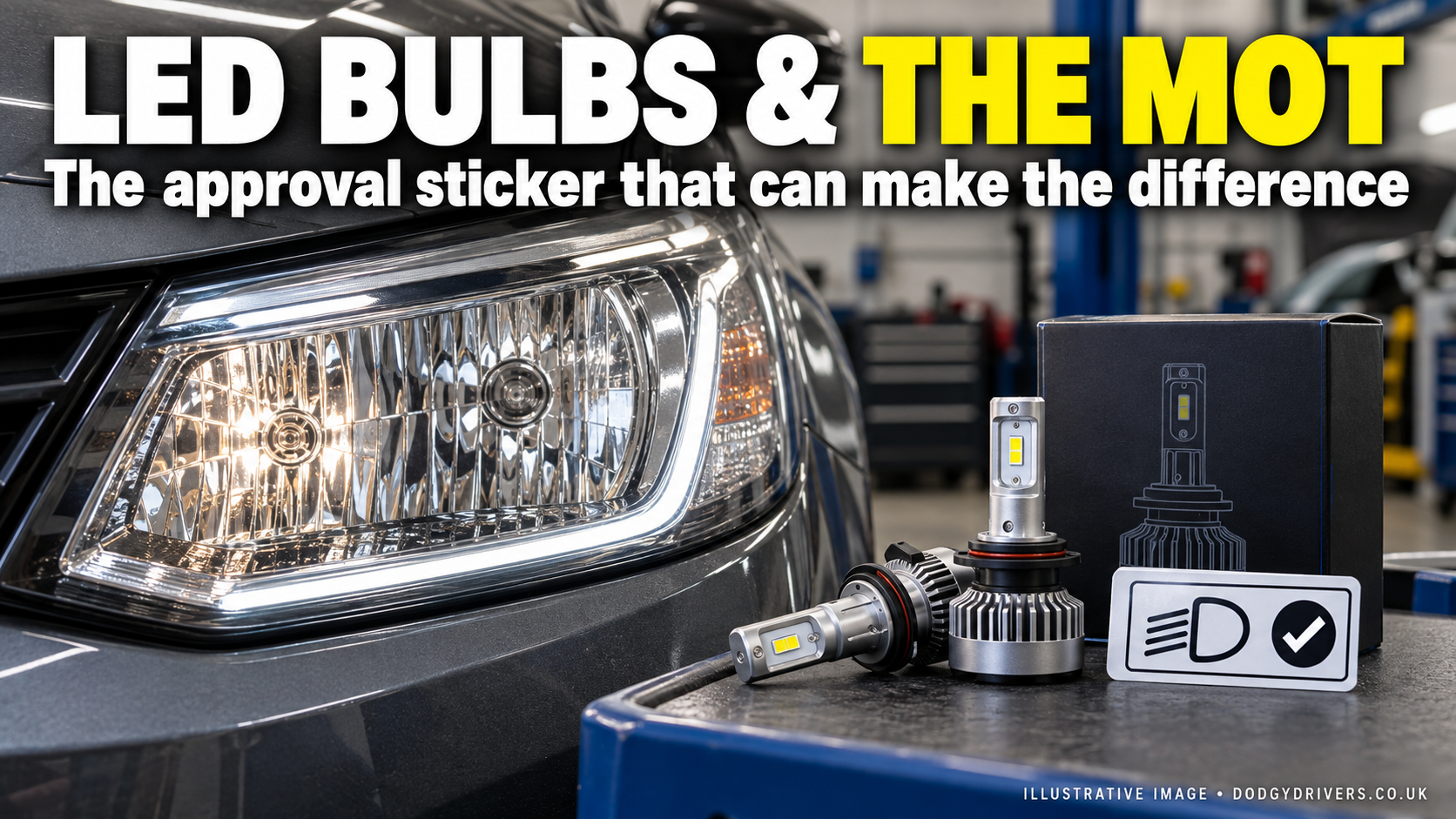
Approved LEDr products come with a secure approval sticker. It must be permanently attached to the vehicle where the tester can see it easily.
The sticker shows the bulb category, such as H11 LEDr, along with the variant, rated voltage, ECE approval number and manufacturer. The DVSA manual also requires an anti-counterfeit security feature, such as a hologram. Testers do not check the approval number or manufacturer details against databases, documents or records. The special notice says they only need to check that the approval sticker is present.
The headlamp must fail if the sticker is missing, unreadable, damaged, appears tampered with, or clearly does not match the fitted bulb. The DVSA manual, section 4.1.4, lists “light source and lamp not compatible” as a major defect and shows an example approval sticker.
A receipt or the original packaging kept in the glovebox does not replace the approval sticker.
Before you buy
Find out exactly which headlamp and bulb type your car has, using the handbook or a reliable parts listing. An H7 or H11 marking does not tell you that a particular LED bulb is approved for your lamp. Ask the supplier to confirm the specific ECE-approved LEDr product and its compatibility with your vehicle.
Make sure the genuine sticker comes in the box and ask where it should go. Phrases such as “road legal” or “LED upgrade” in a listing prove nothing about approval. If the supplier cannot explain the approval and the matching sticker, assume a tester will not accept the bulb.
Fit and aim the lamps properly. The new rule changes only the light-source check. Headlamp condition, operation and beam aim are still tested, and a badly aimed beam dazzles oncoming drivers even with an approved bulb. If the beam pattern looks wrong, get it checked before you drive at night.
Keep the manufacturer’s instructions and product details with your vehicle records. They will help if you replace the bulb later or need to show which variant you fitted.
An MOT pass is not a blanket approval
An MOT tests a vehicle against set criteria on the day. It does not certify every modification in every circumstance. You remain responsible for lights that are correctly installed and do not cause danger or undue glare. The DVSA notice deals only with accepting ECE-approved replacement bulbs in compatible halogen units.
Owners of older cars gain a real option here. The deciding question is whether this specific bulb is approved for your specific lamp, and whether you can show it with the permanent approval sticker. If the answer is unclear, the correct halogen bulb is the simpler choice. A cheap unapproved conversion can still fail the test.
Sources: DVSA, MOT special notice 05-26, published 13 October 2026; DVSA, MOT inspection manual, section 4.1.4.