
About The Author
More than half of Britain’s police-recorded injury collisions involving an animal hazard happened in darkness, according to Volvo Car UK’s analysis of five years of road-safety records. The finding is a useful warning for anyone driving unlit lanes this autumn, but it needs a careful reading: it does not mean that every driver is twice as likely to hit an animal after sunset.
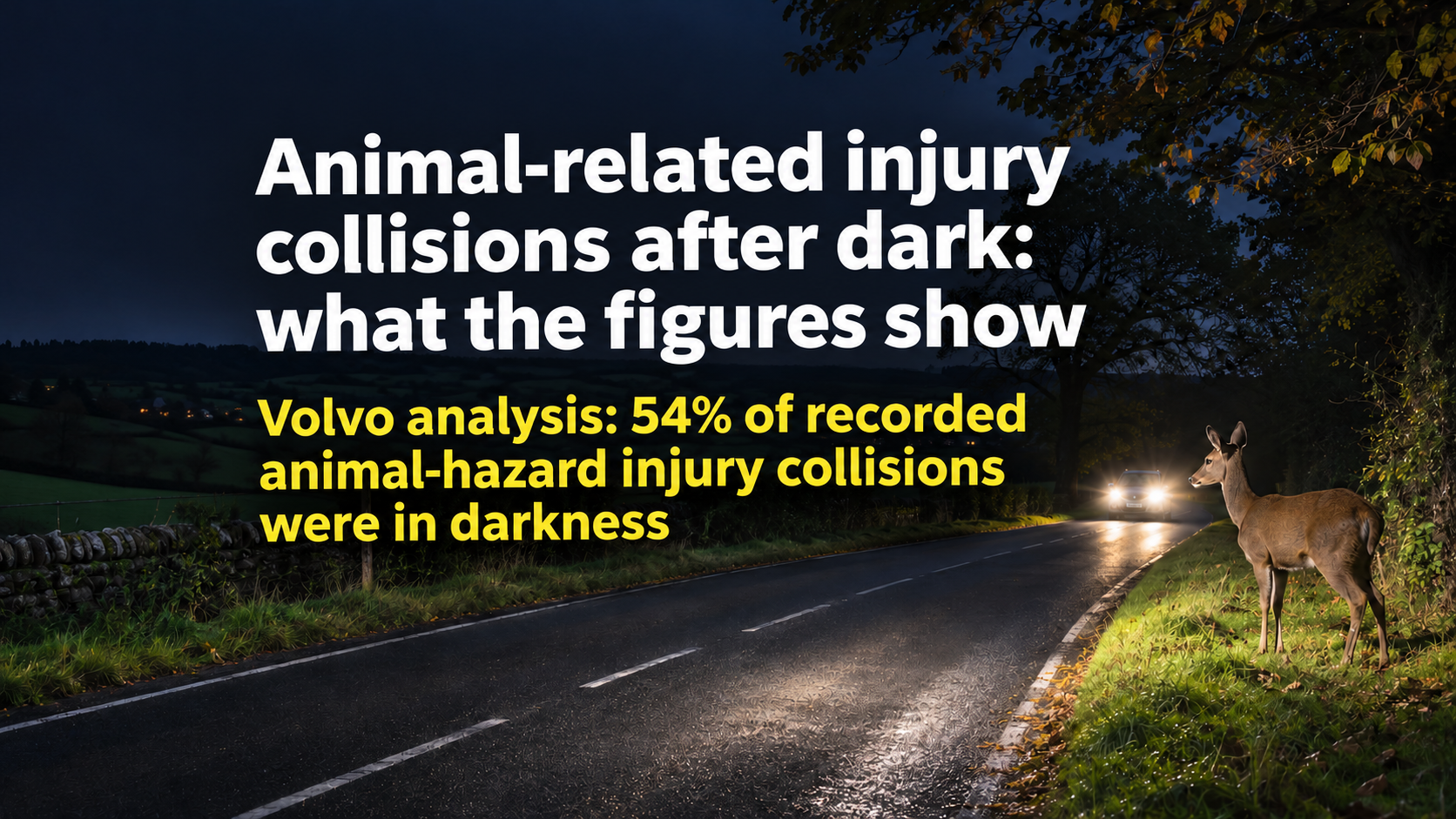
Volvo Car UK examined Department for Transport (DfT) collision records from 2021 to 2025 and identified 1,503 injury collisions in Great Britain in which an animal was recorded as a hazard in the carriageway. Those incidents involved 1,939 human casualties — people killed or injured — across the five-year period. In the company’s analysis, 54% of the animal-related injury collisions occurred in darkness. For all police-recorded injury collisions, the corresponding share was 28%.
That difference matters, especially for drivers whose journeys take them through countryside at dusk. It also raises a question that a headline percentage alone cannot answer: what can the records actually tell us about the risk on any particular journey?
What the 54% figure measures
The original analysis uses the DfT’s STATS19 data, which records personal-injury road collisions reported to the police on public roads in Great Britain. Volvo selected incidents where an animal was coded as a carriageway hazard. That is more precise than saying that 1,503 vehicles physically struck an animal; an animal could have contributed to a collision without being hit.
The figures also leave out many incidents that motorists would recognise as animal strikes. A damaged bumper, an injured deer or a close escape with no human injury may not appear in this particular dataset. The number 1,939 counts human casualties, not animals killed or injured. Northern Ireland is not part of the Great Britain dataset.
The 54% and 28% figures are shares of different groups of recorded injury collisions. They are not rates per mile driven or per hour on the road. Driving volumes, rural-road exposure and the amount of darkness across the year all affect the comparison. Without those denominators, it would be wrong to conclude that the individual driver’s risk is exactly twice as high at night.
Where and when the recorded collisions happened
Volvo found that 79% of the animal-related injury collisions occurred on rural roads. More than one in four — 28% — were classified as fatal or serious collisions. That severity figure describes collisions, not a claim that 28% of the 1,939 people died or suffered serious injury.
There is no single winter-only pattern. August recorded the largest monthly total across the five years, at 157 collisions. October followed with 151 and November with 141. That combination is a reminder that animals can present a hazard in daylight and throughout the year, while longer autumn evenings create a particular visibility challenge for commuting and leisure journeys.
The analysis also found that almost three in ten of these collisions occurred between 7pm and midnight, with 9pm the most common individual hour. These are historical totals across five years, not a prediction that 9pm is the most dangerous time for every road.
The annual recorded counts were 348 in 2021, 339 in 2022, 280 in 2023, 265 in 2024 and 271 in 2025. They should not be treated as a straightforward measure of changes in the number of animal strikes: police recording, road use and the inclusion criteria can all affect what appears in the data.
How to use the information on a real journey
The practical lesson is about the distance in which a driver can see and stop, not about buying a particular safety feature. Rule 125 of the Highway Code says a speed limit is a maximum rather than a promise that the speed is safe, and advises reducing speed at night because hazards are harder to see. Rule 126 says drivers should be able to stop well within the distance they can see to be clear.
On a dark rural road, that means allowing extra room before bends, watching the verges and avoiding a speed that leaves no time to respond if an animal enters the carriageway. If an animal does appear, control of the vehicle and the safety of other road users matter too. An abrupt swerve into oncoming traffic or off the road can turn one hazard into another. There is no manoeuvre that is safe in every circumstance; drivers must respond to the road and traffic actually in front of them.
Modern detection systems may help in some circumstances, but this dataset does not measure the effectiveness of any particular car, camera or driver-assistance product. Volvo’s press release discusses its own large-animal detection technology; that commercial context should be kept separate from the independently maintained DfT records on which the analysis is based.
If a collision happens
Stop somewhere safe and check whether anyone needs emergency help. Do not walk into live traffic to approach an injured animal or recover a camera. If a road obstruction or an injured animal creates an immediate danger, alert the emergency services and give the location.
There are also specific reporting duties. GOV.UK says a driver who hits a dog, horse, donkey, mule, pig, goat, sheep or cattle must stop and contact the police as soon as possible, whether or not the animal dies. For other animals, such as deer, the statutory list is different, but an injured animal or a road hazard still deserves a prompt, safe report to the appropriate police, highways or animal-welfare service.
If a dashcam recorded the incident, preserve the original file and note the time and location. Do not circulate distressing footage or assume that sharing it online is the same as making an official report. Follow the relevant authority’s instructions if evidence is requested.
What the figures should change
The most useful takeaway is neither fear of every country lane nor a precise claim about individual night-time odds. It is that a substantial share of recorded injury collisions involving an animal hazard happened when visibility was reduced, and most occurred on rural roads. The sensible response is to drive within the distance you can see to be clear, leave room for the unexpected and know how to report an incident safely.
The underlying DfT records are publicly available in its road-safety open-data collection. Volvo’s original 22 October analysis explains how the animal-hazard subset was selected. Readers can use both to understand the finding — and its limits.
Leave a Reply
You must be logged in to post a comment.