
About The Author
Faded paint, worn trim and old repairs can be part of a car’s story. Corrosion and unsafe components need action. The difficult part is deciding what to keep.
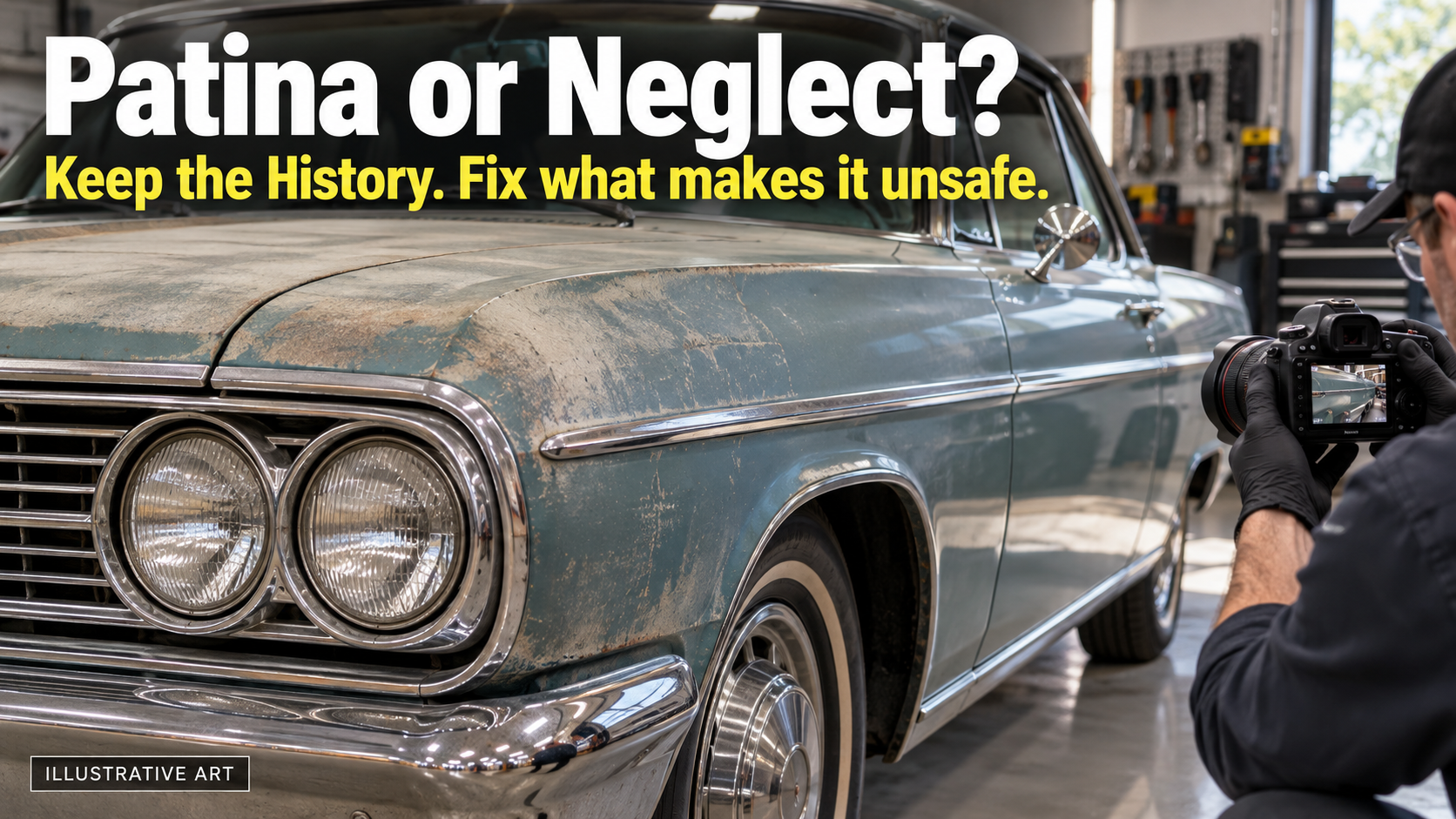
Featured artwork is original AI-generated illustrative art, not a documentary photograph.
Two old cars can look equally scruffy and need very different treatment. One has faded factory paint, worn seats and a sound structure. The other has fresh-looking panels concealing corrosion around critical mountings. Calling both ‘patina’ misses the point. One may carry valuable evidence of age and use. The other may be deteriorating in ways that make it unsafe.
Preservation is not simply a fashionable alternative to restoration. FIVA, the international federation for historic vehicles, says its Technical Commission exists to help owners preserve, restore and use historic vehicles in a historically and technically accurate way. Its identity card records a vehicle’s known history, modifications and state of preservation at the time of inspection. That suggests a useful starting question for an owner: what evidence would be lost if this surface or component were replaced?
First find out what is original
Before sanding, stripping or repainting, photograph the car in good light, including seams, underbody, identification plates, trim, interior wear and evidence of earlier repairs. Gather build records, old photographs, invoices, service books and any manufacturer or club information. Compare the car with period documentation rather than another heavily restored example. If a panel has an unusual finish, establish whether it is factory-applied, a period repair or a much later alteration before calling it original.
A car can be historically interesting without being untouched. A repair carried out during its working life may be part of its story. Equally, a seller’s claim of ‘original paint’ does not become fact because an advertisement repeats it. A specialist paint-depth check, body inspection and documentary history can support the claim, but none is infallible on its own.
Preservation does not mean ignoring deterioration
Corrosion is the dividing line. Surface discolouration on a non-structural panel is not the same as metal loss around a chassis member, suspension mounting or brake-line support. Have the car inspected by someone who understands its construction and known weak points, especially before regular road use. Ask for photographs and a written description of whether each issue is cosmetic, progressing or safety-critical.
A safe preservation plan may mean cleaning and protecting an existing finish while repairing the structure underneath. The aim is not to hide a defect behind a ‘survivor’ story. Record which metal was removed, which was kept and why. A coating is no substitute for an inspection or a structural repair. If a part is safety-critical, roadworthiness takes priority over keeping the original at all costs.
Make every intervention traceable
Treat the car as a sequence of decisions rather than a one-off makeover. Keep an inventory of removed parts, date each photograph and note any material or process used. Label replacements and store serviceable original components where practical. If a specialist advises against reusing an aged tyre, hose, belt or brake component, separate the need for safe replacement from the question of how the car looks on display.
FIVA’s technical material supports recording a car’s historical and technical condition. It does not set a single cosmetic standard for every vehicle. A working classic can carry sympathetic mechanical repairs and visible age. At a concours the class and event rules may weigh authenticity and presentation differently. Ask which standard matters before paying for a finish you may not need.
What UK owners must still check
In Great Britain, a vehicle built or first registered more than 40 years ago does not need an MOT if it has had no substantial change in the last 30 years, according to GOV.UK guidance updated on 19 May 2026. The vehicle must still be roadworthy, and the guidance says an owner who cannot confirm the car is unchanged should not claim the exemption. The guidance covers England, Scotland and Wales, and Northern Ireland has its own vehicle-testing arrangements.
So the preservation argument ends where the safety case begins. An original braking system that is unsafe needs attention. A damaged structure cannot be excused by age or rarity. Keep repair evidence, check your insurance requirements and take model-specific advice rather than relying on an exhibition label or an online comment.
The practical decision
Before any irreversible work, write down what you know about the car, what condition it is actually in and what you want to use it for. Photograph it first and inspect it thoroughly. Repair safety problems, then keep historic details wherever that is compatible with use and condition. A little faded paint can tell a compelling story, and so can an honest, documented repair. Neither should hide the truth.
Leave a Reply
You must be logged in to post a comment.