
About The Author
A fatal crash at a Wolverhampton supermarket has been reported as involving a driver who may have suffered a medical incident. That is an early account, not a confirmed explanation of the collision. The case is a sobering reminder to act early if you feel unwell behind the wheel.
Updated 26 October 2026. This article distinguishes reported facts from what remains unconfirmed.
What has been reported in Wolverhampton
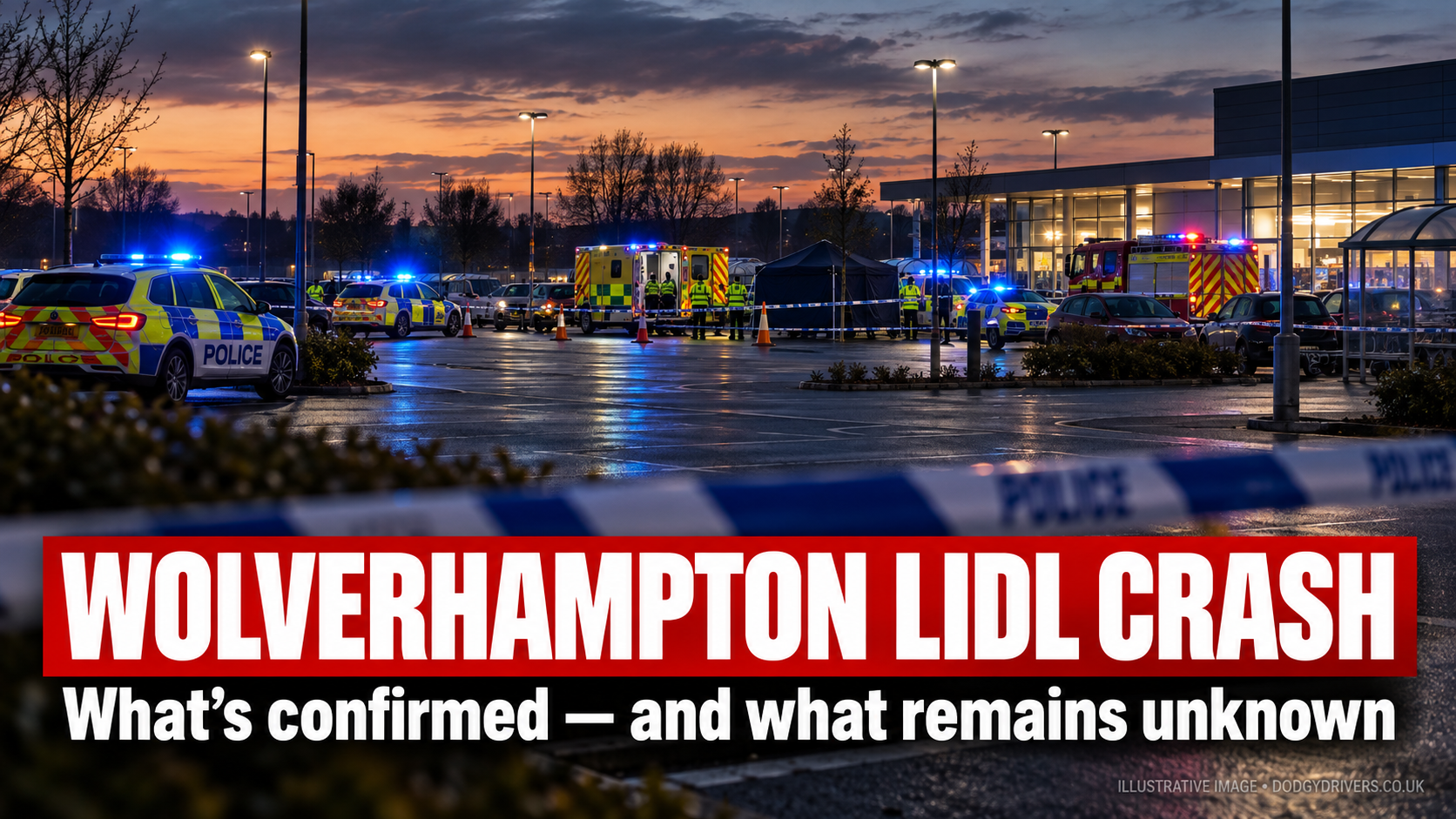
West Midlands Ambulance Service told ITV News that the driver was believed to have suffered a medical incident. The crash happened shortly before 6pm on Friday 23 October at the Lidl on Finchfield Hill. A man in his 30s was pronounced dead at the scene and three other people were taken to hospital. West Midlands Police said the death was not being treated as suspicious, ITV reported.
Those details do not establish the precise medical event, what happened immediately before impact, or whether any underlying condition had previously been diagnosed. Police and medical investigations may establish more. Until then, it would be wrong to assign blame or describe a suspected medical episode as a proven cause.
Source: ITV News, 24 October 2026.
If you start feeling unwell while driving
Do not try to “push through” symptoms that could affect control or awareness. Dizziness, blurred vision, weakness, confusion, sudden severe pain, faintness or a feeling that you may lose consciousness are reasons to stop driving as soon as it is safe. Signal, slow smoothly, and pull into a safe place such as a car park or lay-by. Avoid stopping in a live lane or on a motorway carriageway; if you cannot safely leave the road, use hazard lights and call 999.
Once stopped, switch off the engine and do not set off again until you are fit to drive and any urgent medical concern has been assessed. If symptoms are severe, new, or worsening, call 999. For non-emergency medical advice in England, NHS 111 can help direct you to care; use the equivalent service where you live. Do not ask a passenger to drive you if they are not insured or fit to drive either.
What the rules say about medical conditions
Drivers are responsible for telling DVLA about a medical condition that could affect safe driving. GOV.UK says a person must not drive if a condition is likely to cause a sudden disabling event or if they cannot control a vehicle safely. There are specific rules and exceptions for some short-term conditions, so the right action depends on the diagnosis and the relevant DVLA guidance. A clinician can advise what applies to an individual case.
That does not mean every brief illness automatically requires a licence notification. The question is whether the condition meets the DVLA criteria for that licence group. Check the official DVLA fitness to drive guidance, and use its condition-specific pages or contact DVLA if unsure. Until you have checked, do not drive if you believe you may become unable to control the vehicle.
Planning can reduce pressure when you are ill
People with recurring symptoms can agree a simple plan with their clinician: warning signs that mean “do not drive”, who to call for a lift, and what to do if symptoms begin on a journey. Keep medicines in their original packaging and follow the leaflet or prescriber’s advice about drowsiness. A medicine being prescribed does not automatically make driving safe; the effect on you matters.
Passengers can help by noticing a change in behaviour, asking the driver to pull over when safe, and calling for help. They should not grab the steering wheel or encourage a sudden stop in traffic. If the vehicle is stopped somewhere dangerous, move away from traffic when safe and call emergency services.
A practical note for witnesses
If you witness a collision, call 999 when someone is injured, a road is blocked or there is immediate danger. Give the operator the location, the number of vehicles and any visible hazards. Do not approach a vehicle if there is fire, leaking fuel or moving traffic that makes it unsafe. If you have dash-cam footage, preserve the original file and provide it to police through their requested route; do not post identifying footage online while people may be receiving treatment.
Read our guide to what drivers must do after a collision and our responsible dash-cam submission checklist.
Dodgy Drivers reports on road safety and motoring. This explainer is general information, not medical or legal advice. In an emergency call 999.