
About The Author
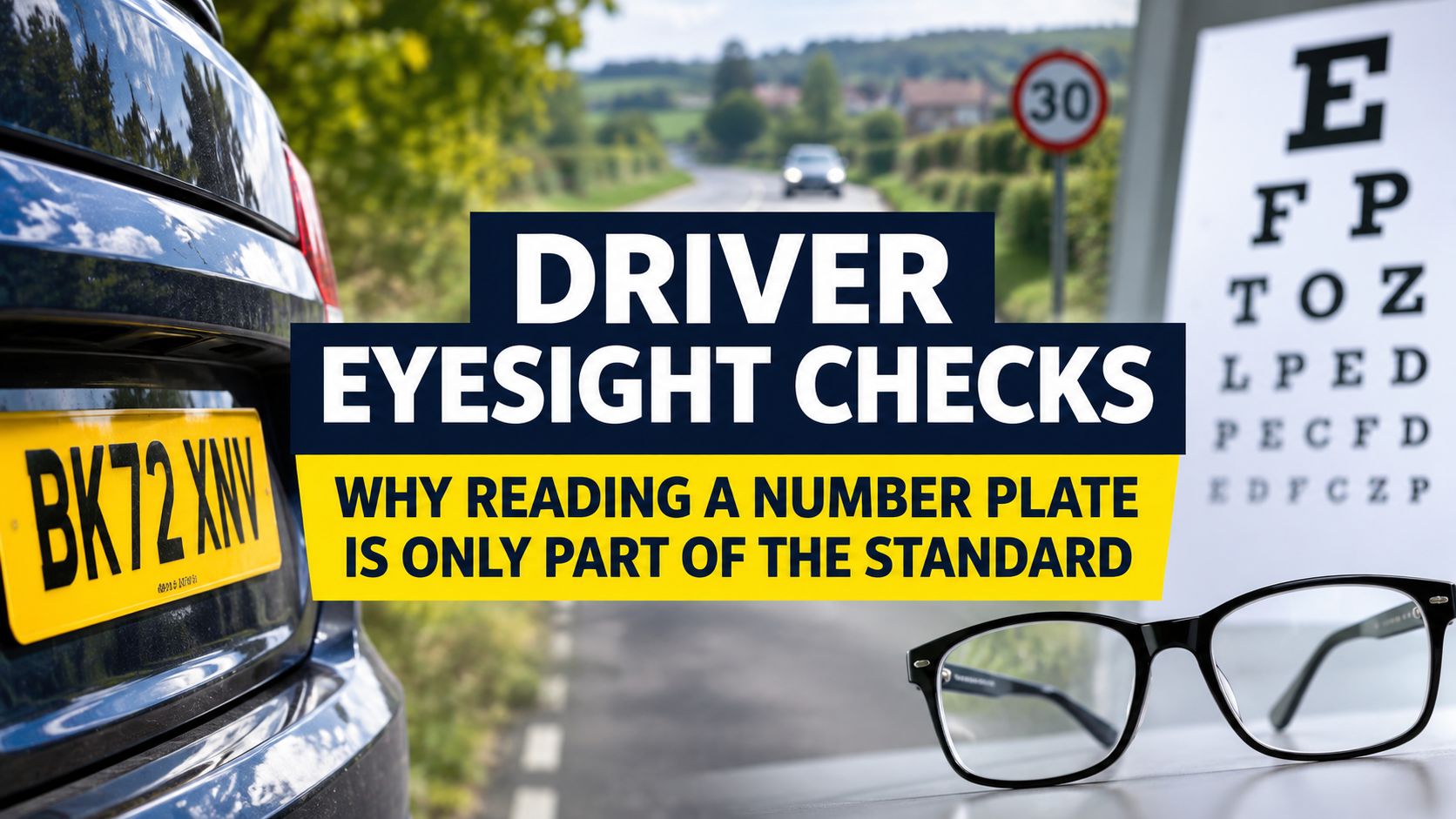
A national police driver-eyesight campaign held between 26 October and 8 November 2026 highlighted an important point: reading a registration plate is only one element of the legal vision standard for British roads.
Northamptonshire Police confirmed its participation on 26 October, explaining that roadside screening involved asking motorists to read a vehicle registration from a measured 20 metres in good daylight, while wearing the glasses or contact lenses they use for driving. Road Safety GB confirmed that the national campaign ended on 8 November.
Passing—or failing—that roadside check carries serious consequences, yet the test itself only measures a fraction of what the law requires.
Three legal requirements, not one
Under GOV.UK’s driving-eyesight rules for Great Britain, motorists must be able to read a car number plate made after 1 September 2001 from a distance of 20 metres, using corrective eyewear if needed. Where a vehicle displays an older-format number plate made before 1 September 2001, the required reading distance increases slightly to 20.5 metres.
However, the statutory standard for ordinary car and motorcycle drivers comprises three distinct criteria. Alongside the number-plate test, drivers must have a visual acuity of at least decimal 0.5 (6/12 on the Snellen scale) measured using both eyes together, or in the remaining eye if they have sight in only one.
Drivers must also possess an adequate field of vision, which requires assessment by an optician rather than a roadside distance check. Lorry and bus drivers are subject to stricter eyesight standards again.
The practical distinction matters. Being able to make out a registration plate across a car park does not confirm that a driver meets the clinical Snellen acuity threshold or has an adequate horizontal field of vision. A home or roadside plate check is no substitute for a proper sight test.
The penalties for failing a roadside test
If a motorist needs glasses or contact lenses to meet the legal standard, GOV.UK states they must wear them every time they drive. Popping to the local shops is not an exemption.
Failing a police roadside eyesight test can have serious consequences. Under the expedited process associated with “Cassie’s Law”, an officer who considers a driver unsafe following a failed eyesight test can ask the DVLA to revoke the driver’s licence urgently. The DVLA reviews the case and, where appropriate, can issue a revocation notice within hours; the officer does not automatically revoke the licence at the roadside. Driving with uncorrected defective eyesight can also result in prosecution. The precise penalties depend on the offence and circumstances.
Routine eye tests and medical declarations
The national Is Your Vision Roadworthy? campaign, supported by UKROEd and Road Safety GB, advises motorists to have their eyes tested every two years, or sooner if they notice any change in their sight.
That two-year recommendation is clinical best practice rather than a statutory guarantee of fitness to drive. Eyesight can deteriorate gradually without a driver noticing, and Great Britain’s licensing system places heavy reliance on personal responsibility. When motorists aged 70 and over renew their driving licence every three years with the DVLA, they are only required to self-declare that their vision meets the legal standard; they do not have to submit an optician’s certificate.
Drivers diagnosed with a specific medical condition affecting their eyes should check GOV.UK’s condition-specific A-to-Z guidance to see whether they are legally required to notify the DVLA, rather than assuming a blanket rule applies to all spectacle wearers. Note that these rules reflect DVLA standards for Great Britain; Northern Ireland operates separate licensing procedures through the Driver & Vehicle Agency (DVA).

Leave a Reply
You must be logged in to post a comment.