
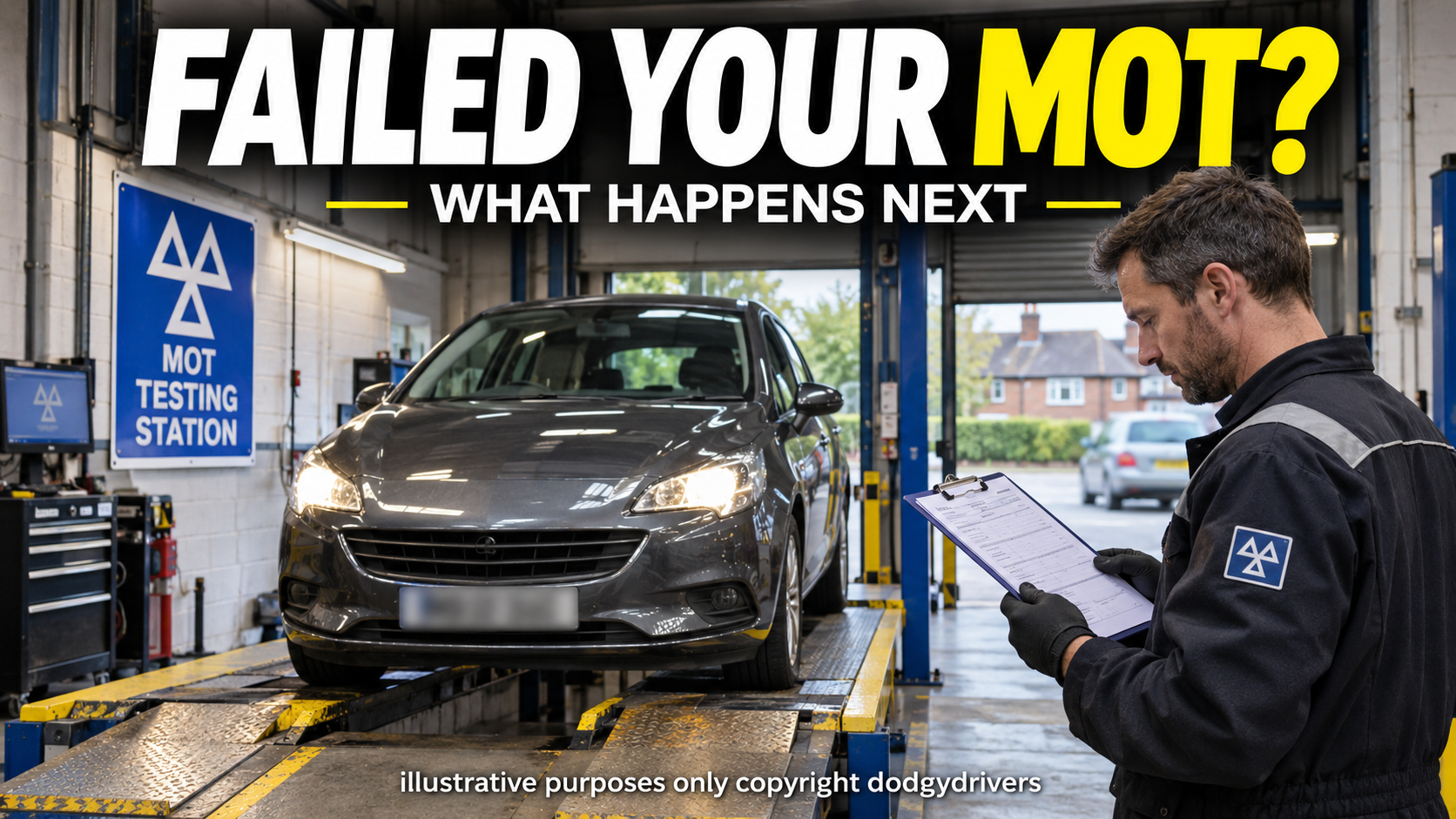
The £2,500 Drive Home: Why “Two Weeks Left on My Old MOT” Won’t Save You After a Fail
About The Author
The receptionist hands you a fail sheet and a scary repair quote. You need the car for work tomorrow, and your old MOT doesn’t expire until next week. Can you just take your keys and drive home? Be careful—one word on that printout changes everything.
We have all stood at that garage counter. You dropped your car off at 8:30 a.m. hoping for a quiet pass and a £54.85 receipt. Instead, the phone rings at lunchtime with the news every driver dreads: it’s failed, the workshop can’t fit the repairs in until next Tuesday, and the estimate makes your eyes water.
Your instinct is to pay for the test, grab your keys, and drive the car home while you shop around for a cheaper quote—especially if you were organized enough to book the test a couple of weeks before your old MOT expired. After all, as every armchair lawyer in the local pub will confidently tell you, “Your old MOT is still legal until the date it runs out, mate.”
Follow that advice blindly, and a ten-minute drive home can cost you £2,500 and three penalty points before you reach the end of the high street.
Whether you can legally drive away from a failed MOT—and how much you will be charged when you bring the car back—hinges on three strict rules that catch thousands of British motorists out every year.
(Note: The rules below cover the DVSA MOT system in Great Britain—England, Scotland, and Wales. Northern Ireland operates a separate government test-centre system through the DVA with different retest windows and booking procedures; Northern Ireland drivers should check official guidance on nidirect rather than assuming Great Britain’s deadlines apply.)
Step 1: Read the Single Word Next to Your Failure
Not all MOT failures are created equal. Under GOV.UK rules, a vehicle fails its MOT if the tester records either a Major defect or a Dangerous defect. Knowing which of those two words is printed on your VT30 refusal notice is the difference between driving home legally and committing a serious motoring offense.
* If your fail sheet lists a “Dangerous” defect: Stop right there. Do not drive the car off the forecourt until the fault is fixed. A dangerous defect means the vehicle poses a direct and immediate risk to road safety or has a serious impact on the environment. It does not matter if your previous MOT certificate still has three weeks left to run, and it does not matter if you are “only driving two miles down the road to another mechanic.” The moment the tester logs that failure, it goes live on the central database used by police ANPR cameras. Driving a vehicle with a dangerous defect can land you a fine of up to £2,500, three penalty points, and even a driving ban—not to mention invalidating your insurance in a crash. If your fail sheet lists only “Major” defects (and zero “Dangerous” ones): The law gives you more breathing room, but with a massive catch. According to GOV.UK, you may drive the vehicle away if* your existing MOT certificate is still in date and no dangerous defects were recorded.
Even then, an in-date certificate is not a get-out-of-jail-free card. The law requires your car to meet minimum roadworthiness standards every time a wheel turns on a public road. If a police officer pulls you over because a failed brake calliper is binding or an exhaust is hanging off, waving an old MOT certificate with ten days left on it will not protect you from prosecution.
And what about Minor defects and Advisories? Neither causes a fail, so you pass and drive away—but treat them as ticking clocks. An advisory for a corroded brake pipe or a tire hovering just above the 1.6mm tread limit is a warning that a cheap fix today will become a dangerous fail tomorrow.
You might also like
 Your car’s first MOT: when it is due, what it costs and what to checkWhen does a new car need its first MOT? Check the three-year rule, maximum test fee, simple safety checks and what happens if the car fails.
 Orphan EV chargers: who looks after ageing home and workplace charge points?As early EV chargers age, owners and employers face questions over maintenance, warranties and repairs. Here is how public charging rules and private electrical safety duties differ.
Step 2: The “Early MOT” vs. “Expired MOT” Trap
Timing your booking changes your legal options the moment a car fails on a Major defect.
Scenario A: You booked early, and your old MOT is still in date. Say your MOT expires on 15 November, and you sensibly book your test for 1 November. The car fails on a Major defect (for example, an emissions fault or a worn suspension bush that isn’t classified as Dangerous). Technically, your old MOT remains valid until 15 November—provided the car is genuinely safe and roadworthy to drive in the meantime.
Scenario B: Your old MOT has already expired. If you waited until your MOT ran out—or failed on the very last day—you cannot simply drive the car home to sit on your driveway while you think about what to do next. Once an MOT has expired, GOV.UK states that a vehicle without a dangerous defect can only be driven directly to have the failed defects repaired, or to a pre-arranged MOT test appointment. Even on that direct trip to a repair shop, the car must still be roadworthy. An appointment in a mechanic’s diary never makes a dangerous car legal.
The Golden Rule at the Counter: Before you leave the test center, ask the tester to walk you out to the car or show you the exact wording on the failure sheet. If there is any doubt about whether the car is safe to stop or steer, leave it on site or pay for a recovery truck. A £70 flatbed tow is vastly cheaper than three points on your licence.
Step 3: How Not to Overpay for Your Retest (The 10-Day and 24-Hour Rules)
Once you know how the car is getting fixed, the clock starts ticking on your retest fee. While the maximum fee a garage can charge for a standard car MOT is £54.85, you rarely need to pay twice if you play the calendar properly:
1. Leave it at the test centre (FREE retest): According to GOV.UK, if your car stays at the original test center to be repaired and is retested within 10 working days following the day it failed, the partial retest is completely free. 2. Take it away for a quick fix and return by the next working day (FREE on specific items): If your car failed only on certain straightforward items listed by the DVSA—such as windscreen wipers, registration plates, mirrors, doors, horn, seatbelts (excluding anchorages), or certain lamps—you can take it away, fix it yourself or elsewhere, and bring it back before the end of the next working day for a free partial retest. Watch out for the classic trap:* Not every bulb or light fault qualifies! Headlamp aim, for example, is specifically excluded from the free next-day lamps list because the tester has to set up calibrated optical equipment to recheck the beam pattern. 3. Take it away and return within 10 working days (Half-price cap): If you take the car to a different mechanic (or your own garage at home) to fix a major mechanical fault and bring it back to the exact same test center within 10 working days, they only need to perform a partial retest—and they can charge at most half the maximum MOT test fee (up to £27.42 for a car, though many garages charge less). 4. Miss the 10-working-day deadline (Full fee): Let the calendar slip past 10 working days—or take the repaired car to a different MOT station altogether—and the tester must carry out a complete MOT from scratch at the full fee.
Your 60-Second Battle Plan When a Car Fails
If you are handed a fail sheet tomorrow morning, don’t panic and don’t get pressured into instant, unitemized repairs: * Demand the paperwork: Keep the VT30 refusal notice and ask for a written repair estimate that clearly separates mandatory Dangerous/Major failures from optional Minor/Advisory work. * Confirm the deadline date: Ask the reception desk to write down the exact calendar date on which your 10-working-day partial retest window expires. * Think twice before touching a disputed part: If you genuinely believe the tester has made a mistake—for instance, failing a component that is clearly within specification—GOV.UK allows you to appeal to the DVSA within 14 working days. However, do not repair, adjust, or replace the disputed part first. The moment another spanner touches the fault before a DVSA examiner inspects it, your right to appeal vanishes.
When an MOT goes wrong, ignore the pub folklore and stick to the three-step checklist: check the defect category, check your old expiry date, and check real-world roadworthiness. Your wallet—and your driving licence—will thank you.


Leave a Reply
You must be logged in to post a comment.