
The 11-Foot Box That Conquered Japan: Why the World’s Smartest Small Cars Aren’t Actually Built for Big Cities
About The Author
From a distance, Japan’s keijidosha regulations look like a recipe for conformity. Look closer at the cars—and the latest ownership data—and you find an entire automotive ecosystem thriving inside a 3.4-metre footprint.
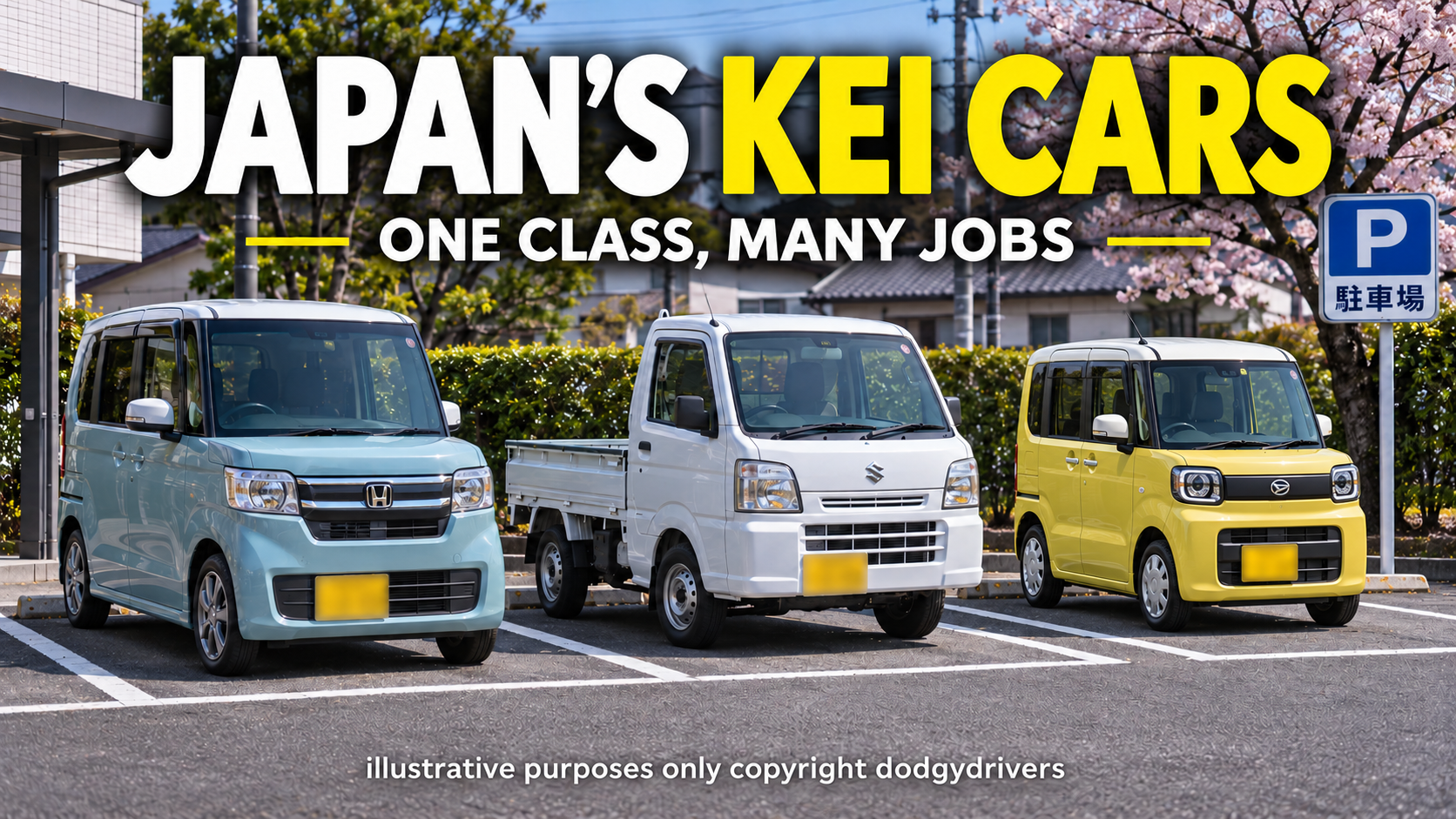
To an outside observer, the phrase “kei car” often conjures a single, uniform silhouette: a tiny, upright city runabout engineered to thread through narrow metropolitan lanes. Yet anyone who spends time examining the Japanese domestic market quickly discovers that the kei category is not a single shape of car at all.
Within one tightly policed legal boundary sits a remarkably varied cross-section of motoring—spanning low-slung three-cylinder hatchbacks, tall family-oriented wagons, and four-wheel-drive commercial vans built to haul cargo.
Just how deeply embedded these vehicles are in everyday Japanese motoring is illustrated by the Japan Automobile Manufacturers Association’s (JAMA) 2025 Passenger Car Market Trends Survey, published in April 2026. Among the Japanese car owners surveyed, kei passenger cars accounted for just under 40 per cent of the vehicle body types held, making them the single most common category reported in the study.
Crucially, those figures require careful context. JAMA’s survey is a snapshot of reported household vehicle ownership rather than a census of every registered vehicle on Japanese tarmac or a tally of annual new-car sales. Even within that frame, however, the distribution is telling: kei passenger cars were reported more frequently in regional areas and smaller cities than in the Tokyo capital region. And among surveyed households keeping more than one vehicle, combinations that included a kei car accounted for about 70 per cent.
Rather than serving a single demographic or a single urban niche, the kei class performs vastly different jobs across the country—all while operating inside the same uncompromising set of physical limits.
A Small Box That Grew With the Times
The statutory perimeter that defines every four-wheel kei vehicle is maintained by Japan’s Light Motor Vehicle Inspection Association (Keikenkyo), which traces the category’s origins back to standards first introduced in July 1949.
In the immediate post-war era, when the priority was basic mechanised mobility, the original four-wheel rules were minuscule by modern standards: a maximum length of 2.80 metres, a width of just 1.00 metre, and a four-stroke engine capacity capped at 150cc. Over the decades that followed, lawmakers periodically revised the rulebook as vehicle engineering, traffic speeds, and safety expectations evolved.
The dimensional framework in force today took effect on 1 October 1998. To qualify as a four-wheel kei vehicle under current standards, a design must not exceed:
- Length: 3.40 metres
- Width: 1.48 metres
- Height: 2.00 metres
- Engine Displacement: 660cc
What makes these regulations so fascinating from an engineering standpoint is the distinction between what the law locks down and what it leaves open. The rules define eligibility for the vehicle class by policing the exterior envelope and swept cylinder volume; they do not mandate mechanical uniformity.
Front-wheel drive, rear-wheel drive, and four-wheel drive all coexist within the class, alongside manual and automatic transmissions, passenger interiors, and stripped-down freight bays. Notably, a statutory horsepower ceiling is not part of the size-and-displacement table published by the Inspection Association—a reminder that the familiar “660cc” badge is merely a regulatory boundary, not a complete summary of how a kei car drives or works.
Three Distinct Answers to the Same Brief
Because the outer dimensions are fixed, product planners and engineers have had to find creativity through packaging. Three longstanding nameplates illustrate how differently manufacturers interpret the exact same rulebook.
1. The Conventional Hatchback: Suzuki Alto
At the traditional passenger-car end of the spectrum sits the Suzuki Alto, a nameplate whose evolution mirrors the regulatory history of the class itself. As Suzuki’s official model archive notes, when a 1990 revision to the kei standards raised the maximum permitted engine displacement from 550cc to 660cc, Suzuki responded by updating the Alto around a newly developed 660cc three-cylinder unit, the F6A. It is a textbook example of how policy and engineering move in lockstep in the kei sector: whenever the legal boundary shifts, manufacturers swiftly re-engineer their platforms to make full use of the new allowance.
2. The High-Roof Passenger Format: Honda N-BOX
While a conventional hatchback keeps its profile low, the kei rulebook’s generous two-metre height limit allows designers to take a very different approach to the same 3.40m-by-1.48m road footprint. Honda’s N-BOX exemplifies this tall, family-oriented passenger format.
In Honda’s domestic lineup, the N-BOX is presented across multiple distinct grades—including Standard, Custom, and the lifestyle-focused Joy variant. By trading the lower silhouette of a traditional small hatchback for an upright glasshouse and a tall cabin, the high-roof format prioritises vertical space and interior flexibility. That architectural contrast is clear in the way manufacturers structure their showrooms, even if the precise reasons an individual buyer chooses a tall wagon over a low hatch remain a matter of inference rather than a survey metric.
3. The Dedicated Workhorse: Daihatsu Hijet Cargo
Step away from passenger transport altogether, and the kei envelope reveals its blue-collar side. A commercial kei van is not a tiny family hatchback pressed into occasional delivery duty; it is a purpose-built utility vehicle engineered from the ground up within the kei limits.
Daihatsu’s web catalogue for the Hijet Cargo illustrates the breadth of hardware available inside the commercial sector. Powered by a 658cc engine, the Hijet Cargo lineup spans multiple grades, transmission choices, and either rear-wheel drive or part-time four-wheel drive. Buyers can specify conventional two-seat enclosed vans built for maximum load volume, or four-seat Deck Van variants that pair a four-person cabin with an open rear utility bed.
Taken together, the Alto, the N-BOX, and the Hijet Cargo show why the kei class resists easy stereotyping. The law dictates where the bumpers and roofline must stop, and how much air and fuel the cylinders can displace. It does not dictate a single body style or a single mission.
What the Survey Data Tells Us—and Where It Stops
Understanding a vehicle category as complex as Japan’s kei sector also requires discipline about what industry surveys can and cannot prove.
When JAMA’s 2025 market survey shows that kei passenger cars are held at higher rates in regional areas and smaller cities than in the capital region—and that roughly seven in ten multi-vehicle household combinations include a kei—it confirms that the category is a foundational part of household transport well beyond Japan’s densest urban core. Yet a statistical correlation in an ownership survey does not, by itself, establish causation. Without deeper evidence, it is overly simplistic to attribute regional popularity solely to road width, parking rules, purchase prices, or local taxation.
To examine how these vehicles actually function in daily life, JAMA conducted a separate 2025 Kei Vehicle Usage Survey between 7 and 15 July 2025, gathering 5,817 samples across both passenger-car households and commercial kei operators. Designed to assess how current owners use their vehicles—and how they view everything from active safety technology to the prospect of battery-electric kei models—the study provides a detailed portrait of the people and businesses who rely on the class every day, while remaining a focused user study rather than a national census of all Japanese motorists.
For enthusiasts, engineers, and transport planners in the UK and other international markets, the enduring lesson of Japan’s kei car is not that a 660cc vehicle built for Japanese regulations could simply be dropped onto foreign roads. Rather, it is a demonstration of what happens when lawmakers establish a clear, stable dimensional envelope and maintain it over decades. Instead of forcing every car into the same mould, a strict boundary has pushed manufacturers to engineer genuinely distinct solutions—proving that even inside the smallest legal box, one size never has to fit all.


Leave a Reply
You must be logged in to post a comment.