
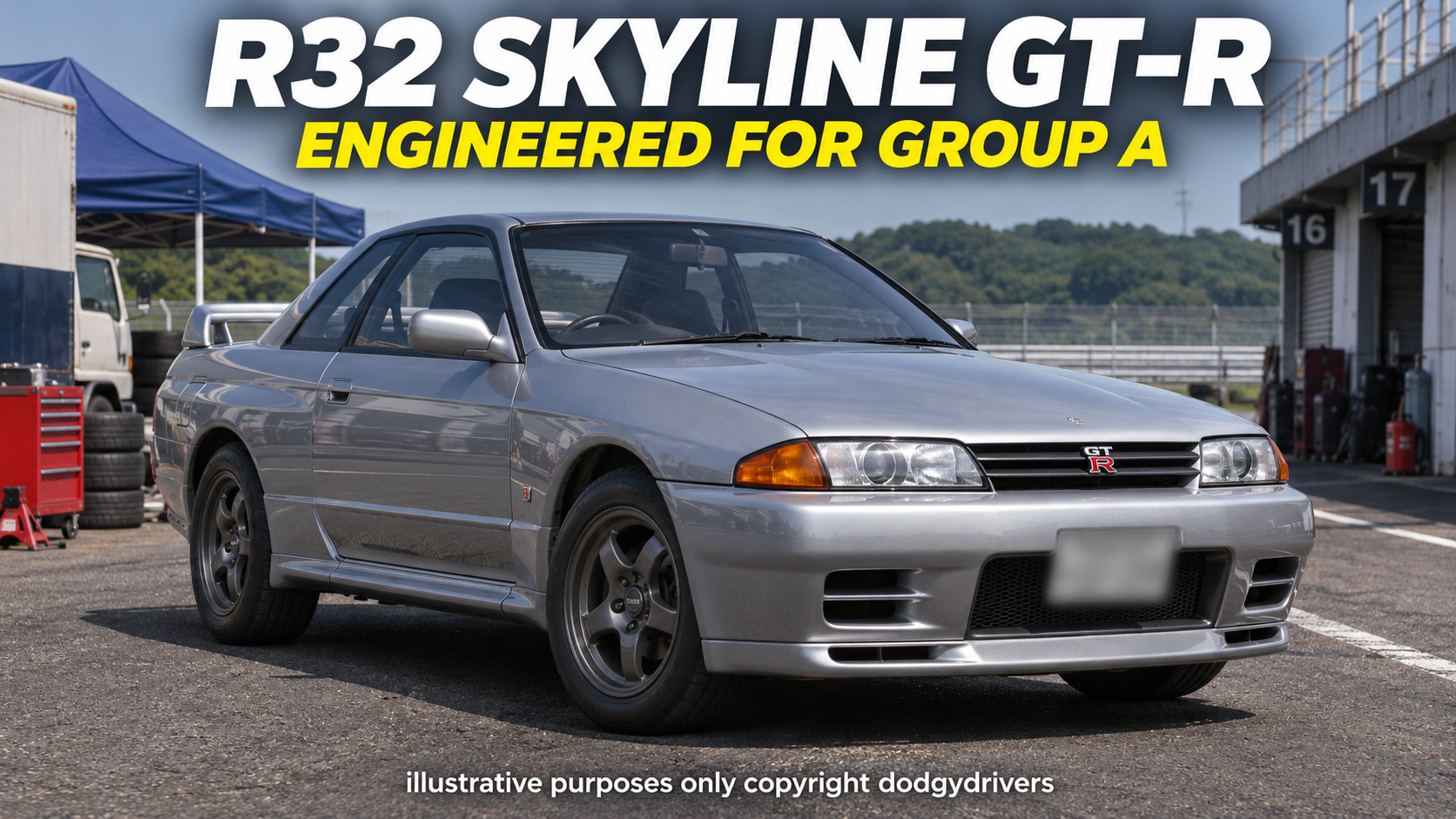
Why the R32 Skyline GT-R Was Secretly Built Backwards—From the Racetrack to the Showroom
About The Author
Everyone knows the R32 Skyline GT-R’s spec sheet by heart. Almost nobody talks about the 1986 ice-lake prototype that proves why those parts were bolted together in the first place.

Spend five minutes reading about the 1989 R32 Nissan Skyline GT-R, and you can recite the catechism in your sleep: a twin-turbocharged straight-six engine, space-age all-wheel drive, and a touring-car trophy cabinet that eventually earned it the nickname “Godzilla.”
Usually, that story is told as if Nissan simply built a brilliant showroom coupe, rolled it out onto the nearest circuit, and acted surprised when it started humiliating everything in sight.
Nissan’s own historical archives tell a much more calculating story. The R32 GT-R wasn’t a road car that stumbled into motorsport glory; it was a Group A racing weapon disguised in a sharp business suit from the moment the first pencil touched the drafting paper.
1986: The Secret Ice Mule and a 16-Year Ghost

When the eighth-generation (R32) Skyline saloon and coupe arrived in Japanese showrooms in May 1989, followed three months later in August by the flagship GT-R, it marked the return of a badge Nissan hadn’t dared to use in sixteen years. Not since the oil crisis killed off the 1973 “Kenmeri” Skyline had a road car worn those three letters.
Yet as veteran Nissan test driver Hiroyoshi Kato later recalled in Nissan’s official heritage archives, the R32 GT-R was expected to compete in Group A touring car racing right from the start of the project.

Long before the public knew a new GT-R was coming, Kato and Nissan’s chassis engineers were already out in the cold testing the hardware that would define it. Archival photographs preserved by Nissan show a camouflaged development mule skidding across an ice course around 1986: on the outside, it wore the boxy bodywork of an older R31 Skyline, while underneath its skin sat the experimental electronically controlled all-wheel-drive system being developed for the R32. Engineers even bolted telemetry equipment onto the older R30 silhouette racer just to gather baseline circuit data for the upcoming car.
Why go to all that trouble years before a showroom launch? Because under FIA Group A rules, a manufacturer couldn’t simply invent a bespoke drivetrain in the racing paddock. If Nissan wanted electronic torque-splitting all-wheel drive, four-wheel multilink suspension, and a twin-turbocharged straight-six on the starting grid on Sunday, it had to engineer them into the road car on Monday.
Solving the 550-Horsepower Traction Problem
Look at the production 1989 R32 GT-R’s specification sheet through a Group A lens, and every number suddenly clicks into focus.

Under the bonnet sat the RB26DETT—an inline-six with twin ceramic turbochargers and six individual throttle bodies, displacing 2,568cc. In showroom trim, Nissan rated the engine at 280 PS (276 bhp), politely observing the Japanese auto industry’s self-imposed power ceiling.
In reality, the iron block and forged internals were engineered for a very different life. Nissan’s heritage record for the 1990 Calsonic Group A race car lists output at 550 PS—nearly double the showroom sticker.
In late-1980s touring car racing, making 500-plus horsepower from a turbocharged engine wasn’t the hard part; rivals like the rear-wheel-drive Ford Sierra RS500 Cosworth were already monsters on the straights. The real problem was keeping the rear tires alive over a 300-kilometer endurance race.
That was the race-car problem the R32’s ATTESA E-TS (Advanced Total Traction Engineering System for All-Terrain with Electronic Torque Split) and four-wheel independent multilink suspension were built to solve. Rather than locking the front and rear axles together like a clumsy off-roader, the R32 behaved like a rear-wheel-drive sports car until sensors detected slip, seamlessly directing up to 50 percent of the engine’s torque to the front wheels in milliseconds. Combined with multilink suspension that kept all four tire contact patches planted under brutal cornering loads, the GT-R could rocket out of wet or dry hairpins while two-wheel-drive rivals were still fighting wheelspin.
What the Famous “29 Wins” Statistic Actually Means
In March 1990, the R32 Skyline GT-R made its domestic racing debut at the opening round of the All Japan Touring Car Championship (JTC) at the tight, twisting MINE Circuit.

Entered by Team Impul in iconic Calsonic blue and driven by Kazuyoshi Hoshino and Toshio Suzuki, the new GT-R obliterated the field. By the time the Group A era of the Japanese championship ended after the 1993 season—making way for 2.0-liter Super Touring regulations in 1994—Nissan’s heritage archive records that the R32 GT-R had won all 29 rounds across the four championship seasons from 1990 through 1993.
Because that “29 out of 29” record has passed into automotive folklore, it is worth stating clearly what the number does—and does not—prove: * It is a specific national championship tally: The 29-win streak refers specifically to the four consecutive seasons of the All Japan Touring Car Championship (with milestone victories independently recorded in Japan Automobile Federation [JAF] archives, such as the 1990 Fuji InterTEC and 1991 SUGO 300km). It is not a blanket claim that no R32 ever lost a race anywhere on earth across every international series it entered.
 * It soon became a Skyline-versus-Skyline civil war: AsNissan’s own archive candidly notes, the R32 was so dominant in the top class of the Japanese series that rival teams quickly abandoned other marques and bought GT-Rs of their own—turning the front of the grid into a ferocious battle between rival Skyline squads like Calsonic Impul, Reebok Hasemi, and STP Taisan.
* The race cars were not showroom cars with stickers: While the 280 PS road car provided the homologated cylinder block, suspension pickup points, and ATTESA E-TS architecture, the 550 PS Group A racers were stripped, seam-welded, purpose-built competition machines.
(Editor’s Note on Historical Rigor: While Nissan’s official heritage archive documents the full 29-race sweep across 1990–1993 and official JAF records confirm individual round victories, historians evaluating the era always distinguish between manufacturer-archived summaries and complete independent season ledgers.)
Why the Blueprint Still Matters
Plenty of fast cars have won races, and plenty of high-tech road cars have dazzled showroom buyers with clever electronics.

The R32 Skyline GT-R achieved cult immortality because of the ruthless sequence in which it was born. Nissan didn’t build a grand tourer and later ask its engineers how to make it survive a racetrack. It identified the physics problem of Group A touring car racing in the mid-1980s, proved the solution on ice in a disguised R31 prototype, baked that hardware into the 1989 production car, and walked away with an undefeated four-year run in its home championship.
Every time you see an R32 on the road today, you aren’t just looking at a nostalgic 1990s coupe. You are looking at the physical receipt for one of the most calculated ambushes in motorsport history.

Leave a Reply
You must be logged in to post a comment.