

About The Author
Charging an electric car to 80% can help support battery health in everyday use. For a specific group of Volkswagen drivers, however, that 80% ceiling has just become a strict safety instruction.
Many electric car owners are familiar with advice to limit routine charging to 80 percent. Under normal circumstances, capping your daily charge at four-fifths full is simply good housekeeping—a gentle way to preserve long-term battery health when you don’t need maximum range for a motorway trip.
For owners of selected Volkswagen ID.3, ID.4 and ID.7 vehicles with high-voltage batteries produced by a particular supplier between 2022 and 2025, however, that 80 percent mark is temporarily no longer a polite suggestion.
Volkswagen is rolling out two UK safety recall campaigns—coded 93MV and 93MF—for selected ID.3, ID.4, and ID.7 vehicles whose high-voltage batteries were manufactured by a specific supplier between 2022 and 2025. According to Volkswagen, charging an affected battery above 80 percent may lead to overheating and a risk of fire.
Before you panic at the sight of an ID badge on your driveway, it is important to read the fine print carefully: not every ID.3, ID.4, or ID.7 is affected; eligibility depends on the individual vehicle. Furthermore, Volkswagen has not published a UK-wide total of included vehicles, and its recall announcement does not list a campaign covering the ID. Buzz.
If you own or lease an ID.3, ID.4, or ID.7, here is exactly how to check where you stand, how Volkswagen’s remote 80 percent lock works, and what happens next.
Step 1: How to Find Out if Your Car Is Included (And What to Do Today)
Volkswagen says it is writing directly to registered keepers of affected vehicles to outline the next steps. However, if you bought your car second-hand recently, moved house, or simply want peace of mind before plugging in tonight, you do not have to wait for the postman.
Contact an authorised Volkswagen retailer with your registration number or 17-character Vehicle Identification Number (VIN) and ask them to check whether your specific car falls under campaign 93MV or 93MF.
If your car is on the recall list, Volkswagen states that you can continue to drive and use the vehicle, provided the battery is never charged above 80 percent until the recall inspection or software work has been completed.
You might also like
 Volkswagen brings Caravelle name back to UK with new people carrierVolkswagen is returning the Caravelle name to the UK, replacing the outgoing Multivan name for its people carrier. Orders have opened, with first deliveries expected in early 2027. Auto Express reported (source)…
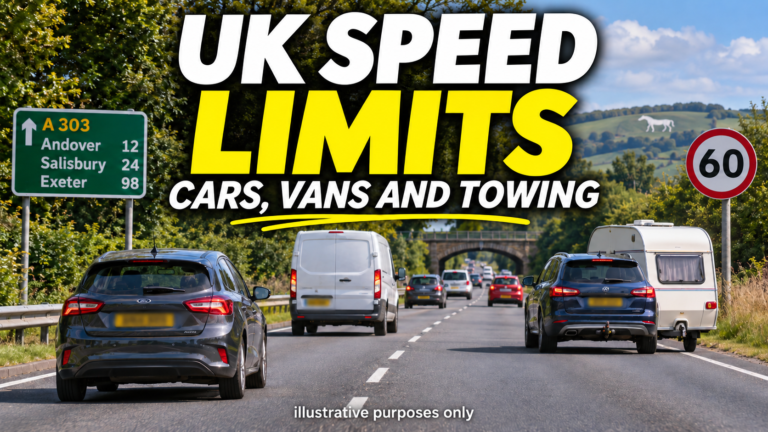 Speed limits explained: what UK drivers need to know about cars, vans and towingUK speed limits can change with vehicle type, road and towing. Check the rules for cars, vans and trailers before your next journey.
Step 2: The “Slider Test” and the 5-Minute Ignition Rule
To protect affected vehicles before they visit a workshop, Volkswagen is taking the unusual step of applying a temporary 80 percent charging cap remotely over the air in most cases.
How do you know if the factory has already locked your car’s ceiling at 80 percent? Volkswagen recommends a simple check on your infotainment screen or smartphone app:
Try to drag the charge-limit slider above 80%. If the remote restriction has been applied, the slider will refuse to stay above the 80 percent mark.
What if your affected car hasn’t received the remote lock yet? According to Volkswagen’s instructions, three conditions must be met for the automatic over-the-air restriction to install: the car must have an active online connection, privacy settings must be turned off (so the vehicle can communicate with Volkswagen’s servers), and the ignition must be switched on for at least five minutes.
The Manual Backup: If your car is confirmed as part of the recall and the automatic restriction still hasn’t taken effect, Volkswagen says you must manually activate Battery Care Mode via the Volkswagen app or the in-car infotainment screen—which automatically pegs the target charge limit to 80 percent—and ensure you do not override it when plugging in. If you are unsure how to check the menu settings on your car, ask your local Volkswagen retailer for assistance.
Step 3: Can You Still Use Rapid Chargers? (And What About Warning Lights?)
A temporary 80 percent ceiling naturally raises practical questions if you rely on your car for long business miles or family trips.
First, the good news: the 80 percent limit applies only to how full you fill the battery, not how fast you charge it. Volkswagen confirms that DC rapid charging at public motorway and trunk-road stations remains completely usable up to the 80 percent limit. Because EV charging speeds often slow as the battery fills, your rapid-charging stops may simply be slightly shorter and more frequent on a long journey.
Second, never ignore what the dashboard is telling you. While an affected car can be driven normally within the 80 percent charge rule, Volkswagen advises owners to contact an authorised retailer promptly if a yellow warning lamp appears on the instrument cluster.
Step 4: The Free Workshop Fix—and Restoring Charging Parameters
The 80 percent restriction is a temporary safety bridge, not a permanent downgrade to your car’s range.
Volkswagen says it will write to affected owners with the next steps. Depending on the vehicle, some cars will require a physical workshop battery check while others will receive a software-based measure. Battery modules will be replaced if necessary.
Crucially for owners:
All recall checks, software updates, and any necessary battery module replacements are completely free of charge.
Volkswagen says the vehicle’s original charging parameters will be restored once all necessary work is complete.
Volkswagen states that while individual cases of property damage have occurred, there have been no confirmed personal injuries linked to the issue. As standard safety practice, Volkswagen reminds drivers that in the event of any vehicle fire, you should stop safely, park outdoors away from buildings or other vehicles if possible, switch off the ignition, get everyone out of the car immediately, and call the emergency services—never attempting to inspect or touch a high-voltage battery yourself.
Because recall campaign details and technical bulletins can evolve, always check Volkswagen UK’s official recall portal and follow the specific instructions issued for your individual VIN. Keeping an unaffected EV at 80 percent is still a smart habit for battery longevity—but for cars included in campaigns 93MV and 93MF, treating that 80 percent line as a hard rule is essential until the workshop gives your battery the all-clear.
Source: Official source.


Leave a Reply
You must be logged in to post a comment.