
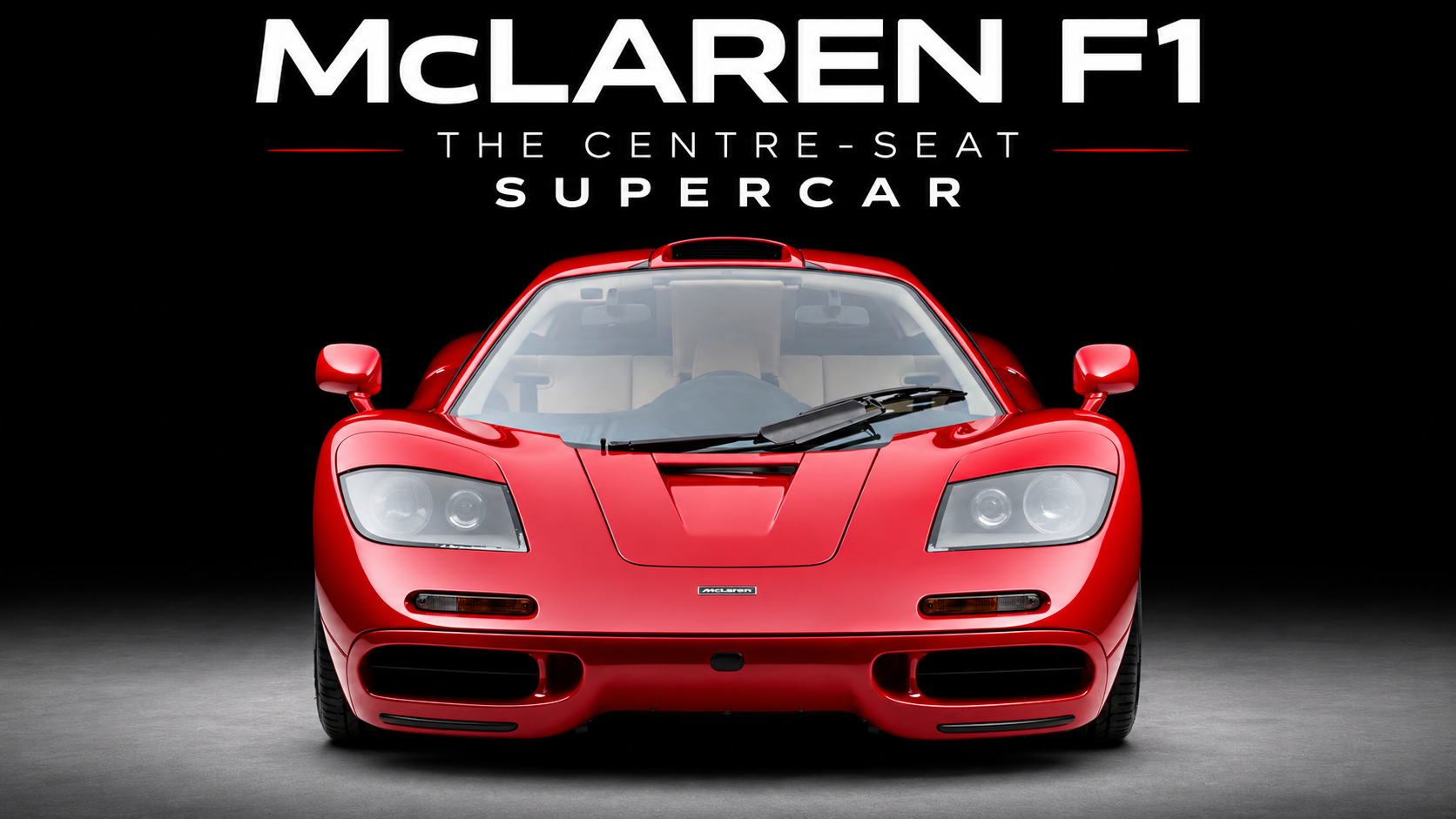
The Crooked Secret Inside Your Dream Supercar—and Why the McLaren F1 Put Its Driver in the Middle
About The Author
Growing up, you probably had a poster of an eighties supercar on your bedroom wall. Nobody told you that driving it meant twisting your spine like a pretzel.
There is a dirty little secret lurking inside the footwells of the most worshipped mid-engined supercars of the 1970s and 1980s. Climb inside, drop onto the leather seat, and look down at your feet. Your chest and shoulders are pointing straight down the road in front of the steering wheel—but your legs are skewed awkwardly toward the center of the car.
In a low-slung, mid-engined sports car, the front wheels sit almost directly beside the driver’s shins. To leave enough room for wide front tires to steer from lock to lock, those wheel arches have to bulge deep into the cabin, shoving the clutch, brake, and throttle pedals inward toward the central chassis tunnel. For decades, buyers paid small fortunes for exotic Italian machinery and simply accepted an offset, crooked driving posture as the price of admission.
Gordon Murray refused to accept it.
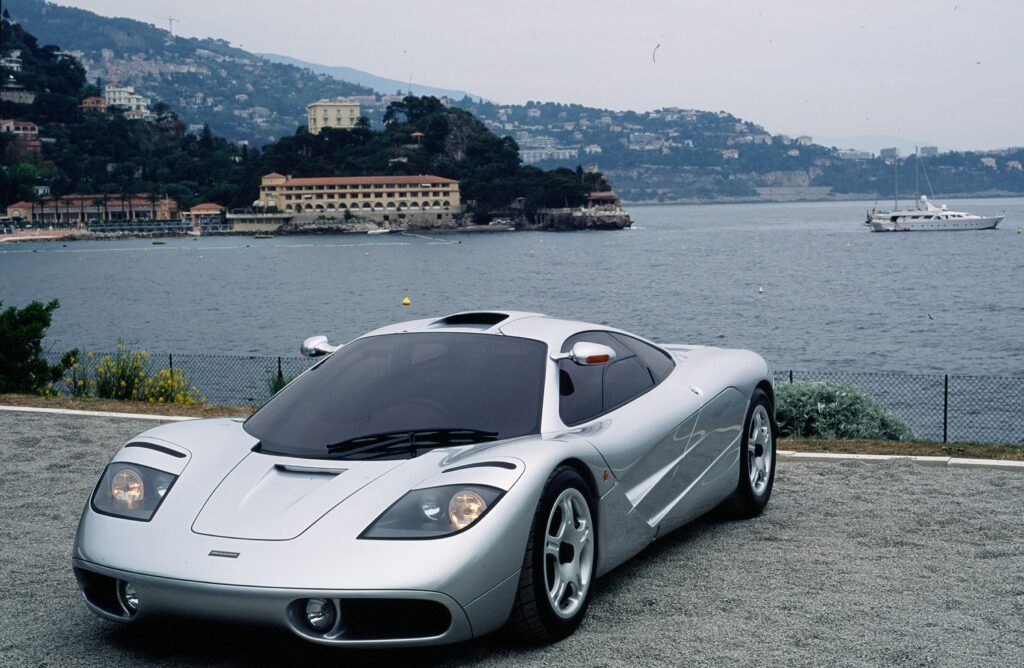
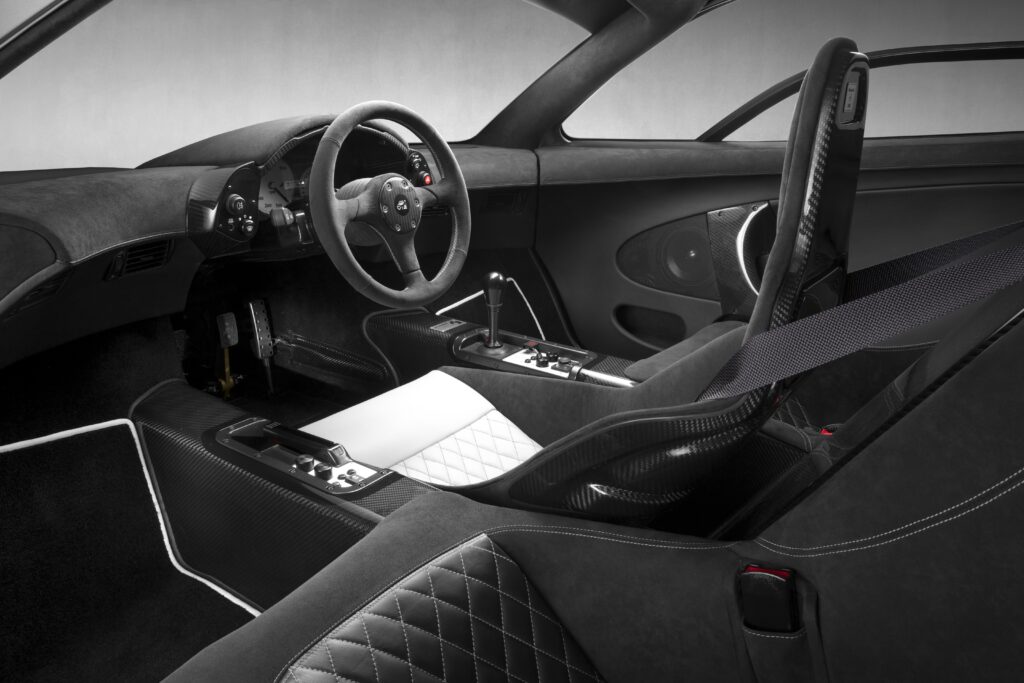
When McLaren pulled the covers off the McLaren F1 in Monaco in May 1992, the world’s automotive press fixated on a cabin layout that looked like a spaceship: three seats arranged in an arrowhead, with the driver sitting dead-center on the spine of the car and two passengers tucked slightly behind and to either side.
It became the car’s ultimate party trick. Yet as Murray and McLaren’s original 1992 launch dossier made clear, moving the driver to the middle wasn’t a styling stunt. It was a ruthless piece of ergonomic problem-solving that simultaneously fixed a classic supercar flaw and gave the person behind the wheel the unmistakable theater of a Formula One cockpit.
From a Delayed Flight in Milan to a Carbon-Fibre Masterpiece
According to McLaren’s heritage archives, the seed of the F1 was planted in September 1988 in an airport departure lounge in Milan. Waiting for a delayed flight home after the Italian Grand Prix, McLaren boss Ron Dennis, shareholder Mansour Ojjeh, marketing chief Creighton Brown, and technical director Gordon Murray began debating what an uncompromising road car built to Formula One standards would actually look like.
When Murray put pen to paper, he started from the inside out. By placing the driver directly on the longitudinal centerline of the F1’s carbon-fiber monocoque—the first ever used in a production road car—the front wheel arches were suddenly miles away from the driver’s feet.
For the first time in a low-slung supercar, the driver’s spine, the steering column, and the pedal box sat in one ruler-straight anatomical line. Better still, the central perch solved a visibility headache that plagues wide cars on narrow country lanes. Instead of peering out from one edge of a wide windscreen and guessing where the far front wing is grazing a stone wall, the F1 driver sat at the apex of a symmetrical view, able to place both front tires to the millimeter.
Flanking the driver’s hips, set slightly further back, were two full-sized passenger seats. Rather than sacrificing practicality to create a selfish single-seater, Murray’s offset three-abreast layout meant the F1 could carry three adults—and their luggage, tucked into bespoke side lockers ahead of the rear wheels—inside a footprint smaller than many contemporary two-seat exotics.
The Road Car That Accidentally Conquered Le Mans
Because the car bore the McLaren name, wore a central seat, and carried a bespoke, naturally aspirated 6.1-liter BMW V12 under a gold-foil-lined engine cover, casual observers often assume the F1 was a disguised endurance racer built to homologate a Le Mans trophy.
In truth, the exact opposite happened. Murray designed the F1 strictly as the ultimate road car; he had no intention of taking it racing.
It took persistent lobbying from wealthy F1 owners—most notably gentleman racers Ray Bellm and Dr. Thomas Bscher—to convince McLaren to develop a competition derivative for the burgeoning BPR Global GT Series. Relenting for the 1995 season, McLaren created the F1 GTR, adding aerodynamic bodywork, upgraded cooling, carbon brakes, and mandatory air restrictors while keeping the road car’s carbon chassis and V12 heart remarkably intact.
After winning on its competition debut at Jerez in February 1995, the F1 GTR took McLaren to the 24 Hours of Le Mans for the very first time that June. Seven GTRs took the start in treacherous, rain-soaked conditions. Twenty-four hours later, the #59 car shared by Yannick Dalmas, JJ Lehto, and Masanori Sekiya took the checkered flag first overall—against purpose-built open-cockpit prototypes—while three more F1 GTRs swept third, fourth, and fifth places, and a fifth finished thirteenth.
That unexpected racing afterlife also explains a number that frequently confuses collectors. McLaren built 106 examples of the F1 across the entire program before production ended in 1998, and the Automobile Club de l’Ouest (ACO), organizer of Le Mans, records that 28 of those were built as GTR competition cars. When you factor in five special-edition F1 LMs, two long-tail F1 GTs, and seven factory prototypes, only 64 cars left Woking as standard F1 road cars. Whenever a single F1 makes headlines today, its individual chassis build sheet tells a far more specific story than the headline “one of 106” figure suggests.
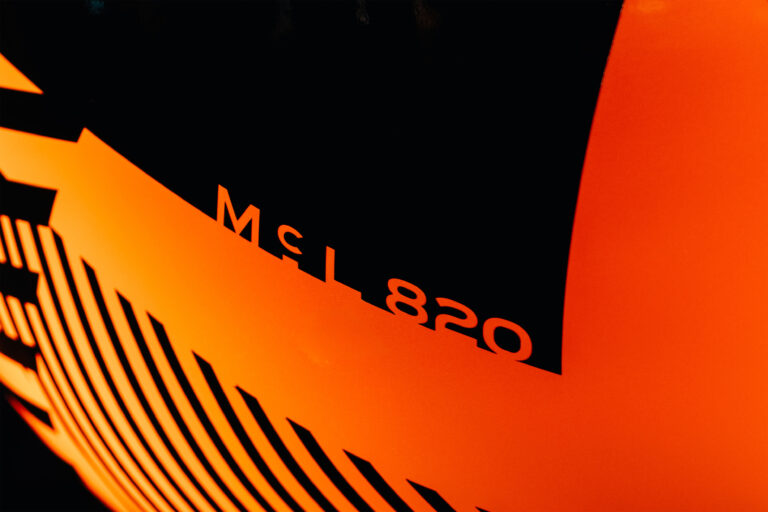
(For a modern chapter in Woking’s road-car story, read our breakdown of how McLaren introduced the McL 820 name and what it has—and has not—confirmed about the 2027 model.)

A 1946 Ghost—and Why Every Supercar Doesn’t Copy It
Striking as the F1’s cabin was in 1992, Murray didn’t actually invent the central driving position. As the ACO’s historical archives point out, two-time Le Mans winner Jean-Pierre Wimille pioneered the exact same concept nearly half a century earlier.
At the 1946 Paris Motor Show, Wimille unveiled a streamlined, rear-engined road-car prototype featuring three seats with the driver placed centrally and pushed slightly forward of two passengers. Wimille built several refined versions over the next two years, though the project died with him following a fatal racing crash in Buenos Aires in 1949.
If sitting in the middle is so ergonomically logical, why hasn’t every modern supercar copied Wimille and Murray?
Because every engineering triumph carries a tax. Putting the driver in the center turns an ordinary kerbside arrival into an athletic routine: you cannot simply swing a door open and drop your hips onto a bolster. You have to step over a wide structural carbon sill and slide across a passenger seat to reach the cockpit.
For a major manufacturer building thousands of cars a year, a central seat also creates a regulatory and packaging nightmare. Side-impact and frontal airbag geometry, heating and ventilation ducting, handbrake and gearshift routing, drive-thru and toll-booth reach, and rear-view mirror sightlines between two passengers’ heads all have to be engineered from scratch. In a hand-built hypercar limited to a tiny production run—like the original F1, McLaren’s later Speedtail, or Gordon Murray’s own T.50—those compromises are part of the magic. In a higher-volume sports car, they are a commercial non-starter.
That is precisely why the McLaren F1 remains a landmark. Its central seat was neither a hollow publicity stunt nor a template for family hatchbacks. It was the purest possible answer to a question most carmakers are too cautious to ask: what happens if you stop building the driver around the car, and build the car around the driver?


Leave a Reply
You must be logged in to post a comment.