
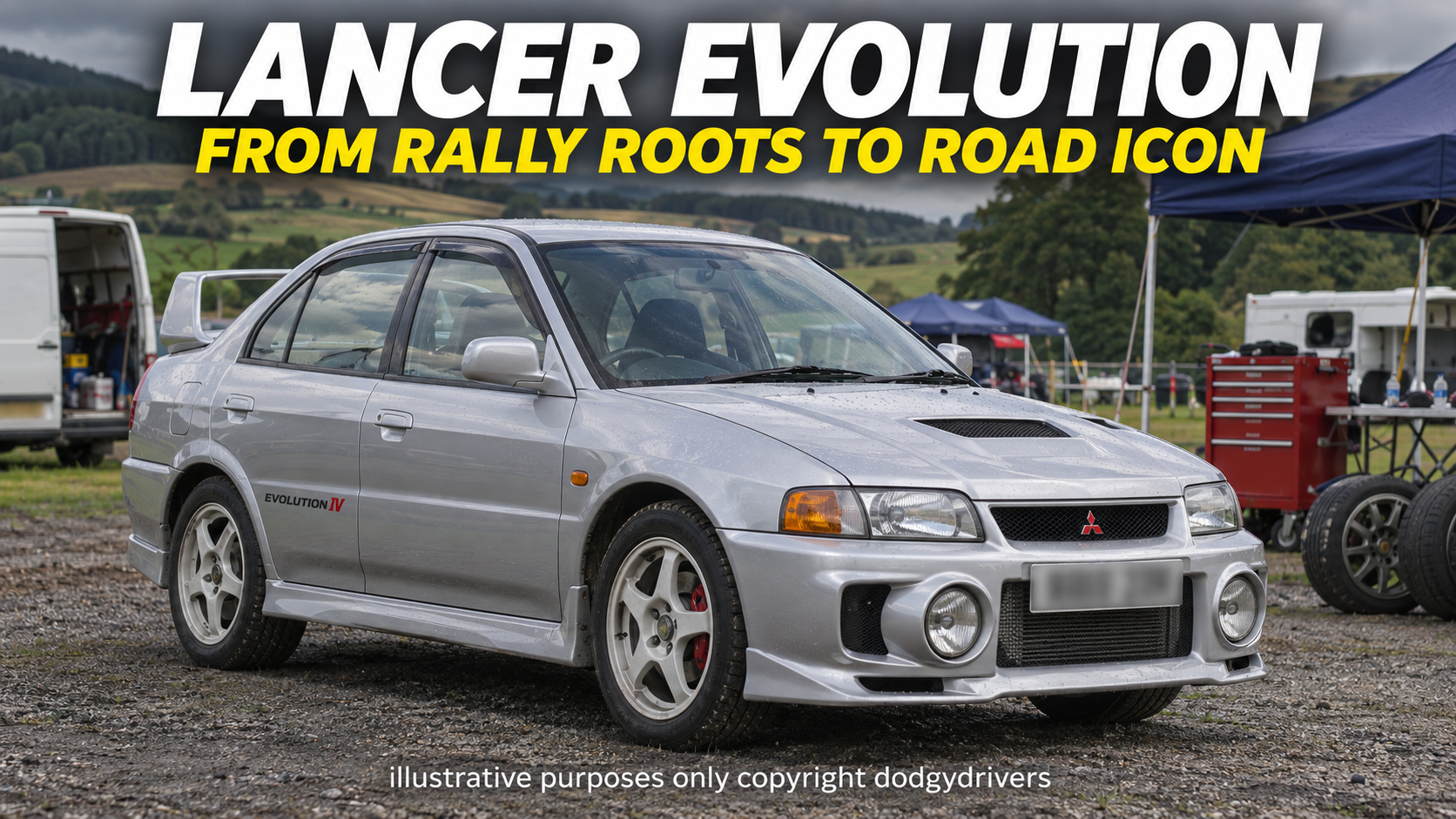
How a £10,000 Economy Saloon Humiliated the Supercar Establishment: The Rise, Reign, and Flawed Genius of the Mitsubishi Evo
About The Author
It had the dashboard of a Tokyo minicab, a fuel range that barely cleared 180 miles, and a servicing schedule that made Ferrari mechanics wince. Yet on a wet, bumpy back road, nothing on earth could touch it.
If you ever want to explain the late 1990s to someone who wasn’t there, tell them about the night a four-door Japanese family saloon with giant spotlights in the front bumper and a Boeing-sized wing on the bootlid pulled up behind a six-figure Italian supercar on a rain-slicked British B-road—and vanished into the distance before the supercar driver had found third gear.
For nearly a quarter of a century, between 1992 and 2016, the Mitsubishi Lancer Evolution did something that irritated automotive snobs to no end: it proved that pedigree was no match for physics.
Across ten generations—counted strictly in Roman numerals from I to X—the “Evo” took a humble commuter box, stuffed it with a furious two-liter turbocharged engine and military-grade differential electronics, and rewrote the rules of cross-country speed.
It wasn’t a polished luxury product. If you actually owned one, you lived with rattling plastics, paranoid ear-straining for drivetrain whines, and a relationship with your local shell-suit-wearing specialist that bordered on Stockholm syndrome. Yet for those who have held the thin Momo steering wheel of a boost-lit Evo as the horizon rushes toward the windscreen, almost every modern performance car feels sedated by comparison.
Here is how an accidental homologation special conquered the world—and why its flaws are just as important to its legend as its trophies.
1992: The Accidental Birth of a Monster (Evo I–III)
The Lancer Evolution exists because its older brother was too fat for Corsica.
At the dawn of the 1990s, Mitsubishi was contesting the FIA World Rally Championship (WRC) with the Galant VR-4. On wide, fast gravel rallies like Finland, the big Galant was a weapon. On tight, twisting European tarmac stages against nimble rivals like the Lancia Delta Integrale, it felt like wrestling a wardrobe down a spiral staircase.
Under FIA Group A regulations, Mitsubishi couldn’t just build a smaller prototype in a shed; they had to build at least 2,500 road-going cars for the public first. So engineers took the Galant VR-4’s iron-block, 2.0-liter DOHC turbocharged 4G63 engine and viscous all-wheel-drive system and shoehorned them into the compact, featherweight fifth-generation Lancer saloon.
Unveiled in October 1992 with 247 bhp (250 PS) and an aluminum bonnet, the Evolution I (CD9A) was supposed to be a cynical paperwork exercise. Mitsubishi hoped they could find 2,500 buyers to clear their throats for rallying. Instead, all 2,500 cars sold out within days, forcing the factory to build another 2,500 immediately.
Those early CD9A and CE9A cars (Evo I, II, and III) were raw, frantic instruments. In standard trim, the Evo I wanted to push its nose wide in tight corners until you learned to pitch it on the brakes like a rally driver. Quick-fire annual updates followed: the Evo II (1993) stretched the wheelbase and widened the track to calm the handling, and the Evo III (1995) added aggressive cooling ducts, higher compression, and a bigger turbocharger for 270 PS.
Sitting in Rugby, Warwickshire, Scottish rally legend Andrew Cowan and his Ralliart Europe team took that Evo III and handed the keys to a quiet, stone-faced Finn named Tommi Mäkinen. In 1996, Mäkinen battered the WRC into submission to claim his first World Championship. The legend was officially loose.
1996: The 180-Degree Revolution (And why the Evo IV Changed Everything)
Ask a casual fan to name the most famous Evo, and they will probably point to a wide-arched Evo V or a striped Tommi Mäkinen Edition Evo VI. Ask an engineer—or anyone who has actually turned spanners on the breed—and they will tell you that August 1996 was the moment the modern Evo was truly born.
That month, Mitsubishi launched the Evolution IV (CN9A). Beneath a sharp new skin dominated by two dinner-plate-sized PIAA fog lights in the front bumper, the engineering team pulled off a mechanical clean-sheet overhaul.
In the first three Evos, the 4G63 engine sat the same way it had in the old Galant, with its timing belt on the left side of the bay. For the Evo IV, Mitsubishi rotated the entire engine and transaxle 180 degrees, putting the cam gears on the right. That single move improved weight balance, equalized the front driveshaft lengths to tame torque steer, and cleared a straighter path for the exhaust and drivetrain. Bolted to the side of the block was a new twin-scroll turbocharger that officially pushed power to 280 PS (276 bhp)—the absolute ceiling of Japan’s famous “Gentleman’s Agreement.”
Even more revolutionary was a black box bolted between the rear wheels on the GSR model. Spearheaded by Mitsubishi driveline guru Dr. Kaoru Sawase, the Evo IV introduced the world to Active Yaw Control (AYC).
Instead of waiting for a wheel to spin and braking it like a clumsy stability-control system, the Evo IV’s computer read steering angle, throttle position, and lateral G-forces, then used hydraulically actuated clutch packs inside the rear differential to actively send more torque to the outside rear wheel mid-corner.
If you have ever driven an Evo IV hard into a wet roundabout, you never forget the first time you feel AYC wake up. Just as your brain expects a front-heavy saloon to wash wide into understeer, you feel an invisible hand grab the rear quarter panel and pivot the nose straight toward the apex. You could get back on the throttle absurdly early, riding a wave of twin-scroll boost while the electronics bent the car around the corner.
Yet the Evo IV also taught owners that living on the bleeding edge hurts. Because the CN9A kept the standard Lancer’s narrow bodywork to stay inside Japan’s cheaper “5-number” tax bracket, tire width was restricted and the front brakes were twin-piston sliding calipers tucked inside 16-inch OZ wheels—brakes that loved to warp discs after a hard B-road blast. Worse still was a phrase that still haunts Evo IV forums today: crankwalk. Early Evo IV 4G63 engines suffered from premature wear on the crankshaft thrust bearings, allowing lateral play in the crank that could ruin a bottom end—especially if an owner fitted a heavy aftermarket paddle clutch.
You might also like
 Three small cars that made clever packaging a big idea: Mini, Fiat 500 and Honda N360The Mini, Fiat 500 and Honda N360 approached the small-car puzzle in different ways. Explore the engineering behind three compact icons.
 Why a fire-damaged Ferrari 500 Mondial sold for $1.875 millionWhy did a fire-damaged Ferrari 500 Mondial sell for $1.875 million? Discover the racing history and rarity behind the auction result.
1998–2000: Wide Arches and World Domination (Evo V & VI)
Mitsubishi’s response to the Evo IV’s limits was brutal and immediate.
In 1997, the FIA introduced looser “World Rally Car” rules that allowed rivals like Subaru and Ford to widen their cars and modify suspension pickups without building road-going equivalents. Mitsubishi refused to play along. Sticking stubbornly to production-based Group A rules, they reasoned that if the rally car needed wider tracks and bigger brakes, the road car would just have to get wider too.
The 1998 Evolution V (CP9A) tore up the tax-bracket dimensions. Out came blistered bolt-on wheel arches, lightweight aluminum suspension arms, 17-inch wheels, and massive 4-pot Brembo brakes as standard—along with a revised split thrust-washer inside the 4G63 to banish the Evo IV’s crankwalk gremlins.
That season, Mäkinen and young British star Richard Burns turned the WRC into a Mitsubishi parade, winning seven rallies between them to secure both the 1998 Drivers’ title and Mitsubishi’s first (and only) WRC Manufacturers’ crown.
A year later came the Evolution VI (1999), shifting the front number plate to the left to feed colder air into the intercooler, followed at the end of 1999 by the holy grail for collectors: the Evo VI Tommi Mäkinen Edition (TME). Celebrating the Finn’s unprecedented fourth consecutive world title, the “Evo 6.5” dropped the ride height on tarmac-spec suspension, sharpened the steering rack, and fitted a quick-spooling titanium-aluminide turbine wheel. On a dry back road, the TME felt less like a saloon car and more like a hyper-caffeinated terrier.
2001–2016: Heavy Metal, Top Gear Fame, and the Final Curtain (Evo VII–X)
As the 2000s arrived, safety regulations grew heavier—and Mitsubishi’s stubbornness in rallying finally caught up with them.
Built on the larger, heavier Lancer Cedia platform, the 2001 Evolution VII (CT9A) initially shocked enthusiasts with its upright, sensible styling. Under the skin, however, Dr. Sawase struck again, pairing rear AYC with an Active Center Differential (ACD) that let drivers toggle between Tarmac, Gravel, and Snow modes on the dashboard. Ironically, just as the road car became an all-weather computer genius, the FIA forced Mitsubishi to abandon Group A and build a true WRC car mid-season in 2001. Bereft of the old Group A magic, the works rally team slid into a winless spiral from which it never fully recovered.
On the street—and especially in Britain—the CT9A generation (Evo VII, VIII, and IX) became a cultural phenomenon. Alongside a flood of Japanese grey imports, official UK distributor Ralliart UK (under the Colt Car Company) began commissioning wild, warranty-backed FQ editions (“Fing Quick,”* according to everyone outside the legal department).
The Evo VIII (2003) introduced Super AYC with planetary gears that doubled cornering torque transfer, peaking in Britain with the unhinged MR FQ-400: a two-liter four-cylinder saloon pumping out 405 bhp that famously humiliated a Lamborghini Murciélago around the Top Gear test track—right after Jeremy Clarkson demonstrated its chasmic turbo lag by getting outrun in fifth gear by a basic family Fiat.
By 2005’s Evolution IX, the venerable iron-block 4G63 gained MIVEC variable valve timing, creating arguably the greatest point-to-point driver’s car of the entire lineage before the 2007 Evolution X (CZ4A) changed the recipe one last time. Retiring the 4G63 after fifteen years in favor of the all-aluminum 4B11T engine, an optional twin-clutch TC-SST gearbox, and integrated S-AWC electronics, the Evo X was faster, safer, and vastly more refined—right up until Mitsubishi pulled the plug with the 2015/2016 Final Edition to focus on crossovers and plug-in hybrids.
The Honest Truth: What It Actually Takes to Love an Evo
Romantic retrospectives love to pretend Japanese performance icons are unbreakable appliances. Anyone who has actually signed the V5C logbook on an Evolution knows better.
Owning an Evo—especially an early-to-mid generation car in the UK—is a contact sport:
The Three Red Lights of Doom: On Evo IV through IX GSRs, the hydraulic AYC/ACD pump is mounted underneath the rear of the car, right where British winter road salt loves to fester. Moisture corrodes the aluminum pump body internally until Tarmac, Gravel, and Snow* all light up red together on the dash—followed by a four-figure rebuild bill.
* The Rust Monster: Built for salt-free Japanese domestic roads, early grey imports left the factory with virtually zero underbody wax protection. Rear chassis legs, boot floors, and front strut towers dissolve if left unsealed in a damp British climate.
* Servicing & Thirst: Official schedules on the golden-era cars demanded fresh engine oil and AYC fluid checks every 4,500 miles. Combine that with a tiny 45-to-50-liter fuel tank and a thirsty boosted 4G63, and a hard Sunday morning drive means visiting the V-Power pump every 160 miles.
So why do we forgive them?
Because the Mitsubishi Lancer Evolution is a breed of car that can never be built again. No modern boardroom will ever sign off an annual engineering war where diffs, turbos, suspension geometry, and widebody fenders are reinvented every twelve months just to shave half a second per kilometer off a Welsh gravel stage.
When you sit behind the wheel of an Evo—looking out over the vented bonnet as the turbocharger inhales and the chassis pivots beneath your hips—you aren’t driving a marketing department’s lifestyle exercise. You are driving a piece of World Rally history that only wore rear doors and a bootlid because the rulebook said it had to.

Leave a Reply
You must be logged in to post a comment.