
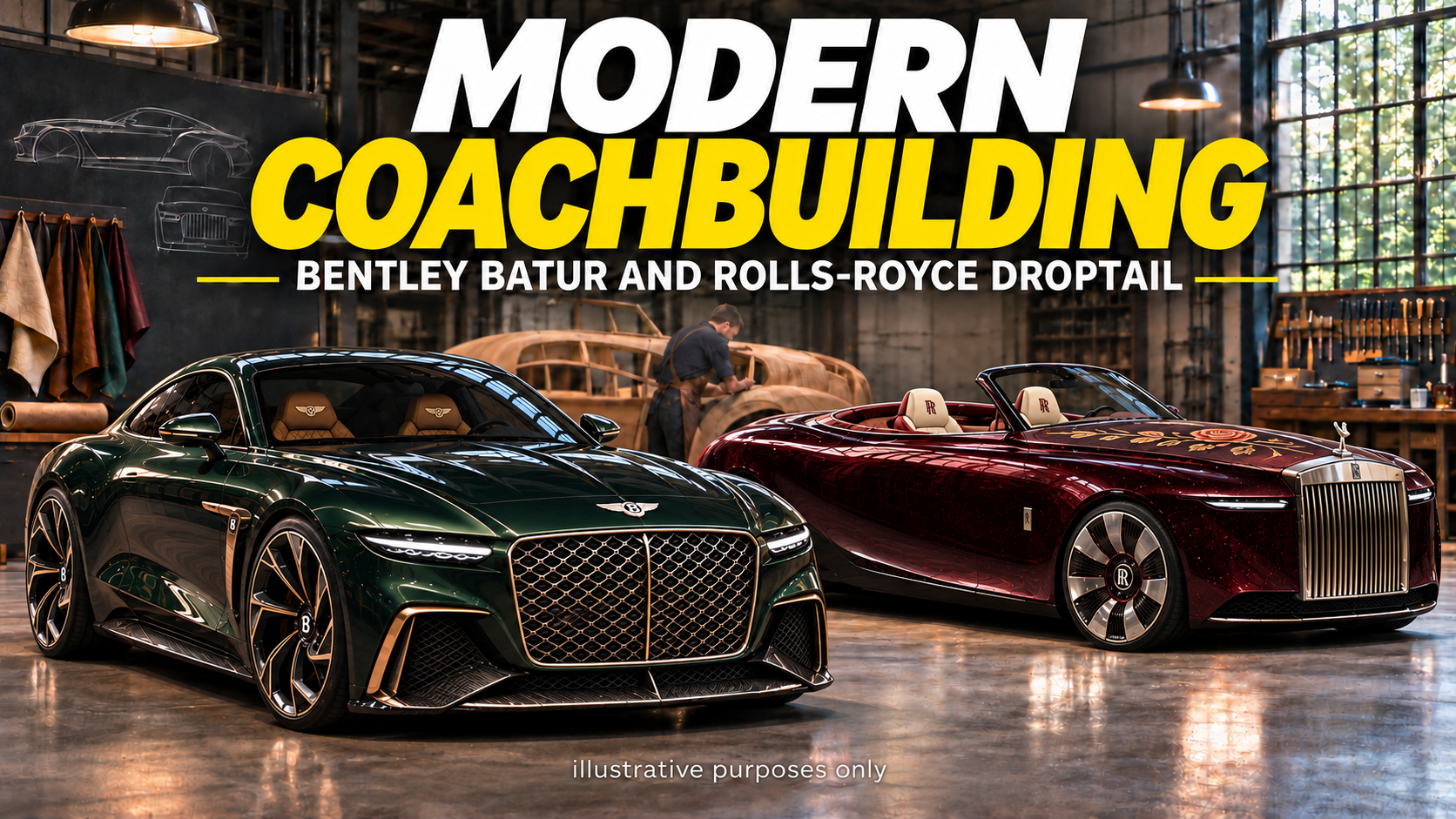
When a £1.65 Million Supercar Is Still Too Common: Inside the Secret World of Modern Coachbuilding
About The Author
Anyone with a healthy bank balance can tick every box on a luxury car options list. True coachbuilding begins where the brochure runs out of pages.
Spend a million pounds on a modern supercar or luxury limousine, and you can still suffer an awkward moment in the valet lane at Monaco or Mayfair: pulling up directly behind the exact same car, differentiated only by the color of its brake calipers and the contrast stitching on the dashboard.
Expensive options only change the trim of a standardized product. Coachbuilding is meant to change the product itself.
In the 1920s and 1930s, the rules of the game were clear. A wealthy buyer ordered a “rolling chassis”—frame rails, an engine, a gearbox, and a radiator—from Bentley or Rolls-Royce, and shipped it to an independent atelier like Mulliner, Hooper, or Park Ward to have a bespoke aluminum or steel body hand-beaten over an ash wood frame.
Modern unibody engineering, global crash-test regulations, and complex airbag sensors made that old cottage industry virtually impossible. In response, the world’s top luxury marques brought coachbuilding back inside the factory gates. Yet as two headline British projects—Bentley’s Mulliner Batur and Rolls-Royce’s Droptail—demonstrate, even Britain’s two most storied luxury houses use the word “coachbuilt” to describe two very different tiers of exclusivity.
Bentley Mulliner Batur: 18 Patrons, One Master Blueprint
When Bentley unveiled the Mulliner Batur in August 2022, it presented the coupé as the pinnacle of its in-house coachbuilding division. Limited to a run of just 18 cars, each carried a base launch price of £1.65 million before local taxes and bespoke options were added—and every build slot was spoken for before the public even saw the car. (As ever in the collector world, a period launch price is a baseline snapshot, not a clue to what any individual buyer ultimately spent at Crewe or what the car might fetch today.)
Look closely at the Batur’s brief, and you can see where modern series coachbuilding draws its boundaries. Bentley wasn’t offering 18 blank sheets of paper with 18 unrelated body shapes. Instead, the Batur was a tightly defined, 18-car engineering and design program.
Mechanically, it served as a thunderous farewell to Bentley’s iconic 6.0-liter twin-turbocharged W12 engine. Visually, however, Bentley used the Batur’s cleaner, tauter body panels and “endless bonnet” line as a rolling manifesto to preview the styling language of its future battery-electric road cars.
Once that shared exterior silhouette was locked in, the 18 buyers were invited to collaborate with Mulliner’s design team on an extraordinary palette of materials. Rather than choosing from a showroom dealer book, clients could specify sustainable natural-fiber composites in place of carbon fiber, low-carbon Scottish leathers, titanium exhaust finishers, and even hallmarked, 3D-printed 18-karat gold for cabin touchpoints like the drive-mode dial and Bentley’s traditional “organ stop” air-vent controls.
Each of the 18 cars is genuinely one of a kind in its finish, yet they remain siblings sharing a single sculptural template.
You might also like
 Three small cars that made clever packaging a big idea: Mini, Fiat 500 and Honda N360The Mini, Fiat 500 and Honda N360 approached the small-car puzzle in different ways. Explore the engineering behind three compact icons.
 Will Your Old Hot Hatch Become a Classic? What the Big Auction Prices Don’t Tell YouSome once-ordinary performance hatchbacks have become collector favourites. That does not make every worn example an investment—and the differences are instructive.
Rolls-Royce Droptail: Four Cars Built Around Four Biographies
Forty miles south of London in Goodwood, Rolls-Royce approached the Droptail program from a much more intimate starting point. Unveiled in August 2023, Droptail was conceived as a quartet of just four cars—and while they share an underlying two-seat roadster architecture and a removable electrochromic-glass hardtop, each commission was designed around the personal biography of a single patron.
The first to break cover, La Rose Noire, took its visual cues from the Black Baccara rose—a dark, velvety flower native to France and adored by the mother of the commissioning family. To mimic the look of scattering rose petals across the cabin, Rolls-Royce artisans hand-assembled an intricate parquetry mosaic out of 1,603 triangles of black sycamore wood veneer, a single element that took nearly two years to perfect. An Audemars Piguet Royal Oak Concept timepiece was engineered to clasp into the dashboard and detach to be worn on the owner’s wrist, while a motorized champagne chest was tailored to match at the push of a button.
Days later, Rolls-Royce revealed the second commission, Amethyst Droptail, shaped around the cultural heritage of a different patron and the amethyst birthstone of their son. Here, the dashboard centerpiece was a removable handmade Vacheron Constantin timepiece, and the rotary controls were polished with real amethyst gems.
More remarkably, the patron requested that the vast rear aft deck behind the cockpit be clad in open-pore Calamander Light wood. According to Rolls-Royce, that rear deck isn’t just visual theater—it is an aerodynamically functional exterior wood surface that actually generates rear downforce at speed.
Notice what is missing from Rolls-Royce’s extensive press dossiers for both cars: a price tag. While internet speculation routinely throws around eye-watering eight-figure guesses, Rolls-Royce has never published official transaction figures for the Droptail commissions. Comparing an invented rumor to Bentley’s £1.65 million Batur launch price misses the point entirely: at the level of a four-car personal commission, there is no standard retail sticker.
Why Billionaire Experiments Matter to Real-World Engineering
It is tempting to look at motorized champagne chests and 3D-printed gold switches and write the whole exercise off as gilded theatre for the ultra-wealthy.
Strip away the luxury indulgence, however, and modern coachbuilding reveals something genuinely useful about how cars are engineered. In a mainstream factory producing 100,000 vehicles a year, accountants kill unusual materials on sight because the tooling and testing costs are too high for a narrow profit margin. Ultra-low-volume coachbuilding reverses that equation: a tiny handful of patrons effectively fund extreme materials research.
Consider that wooden rear deck on the Amethyst Droptail. Putting raw, open-pore timber on the outside of a high-speed car where it acts as an aerodynamic surface isn’t a matter of calling a cabinetmaker. Rolls-Royce’s engineers had to develop new protective coatings and subject wood veneer samples to more than 8,000 hours of environmental torture testing—blasting them with simulated desert sunlight at 80°C, freezing them to -30°C, and pelting them with rain and road grit so the timber wouldn’t warp, crack, or fade. Similarly, Bentley’s work with natural-fiber composites and additive metal manufacturing on the Batur tests production techniques long before they are subtle or cheap enough for series road cars.
Of course, a healthy dose of critical thinking still applies whenever a manufacturer unveils a coachbuilt masterpiece. Official studio photographs and glowing press releases cannot independently verify how an experimental veneer will look after twenty summers in the Mediterranean sun, what the project truly cost the factory to build, or whether a deeply personal bespoke specification will ever appeal to a second buyer at auction decades from now.
What the Batur and the Droptail prove is that “bespoke” is no longer a binary word. Customizing a car changes the details of a product; coachbuilding changes the boundaries of the car itself. Bentley and Rolls-Royce have staked out two distinct territories on that map—one celebrating the limited-edition design series, the other turning a patron’s family history into sheetmetal and timber.
Leave a Reply
You must be logged in to post a comment.