
About The Author
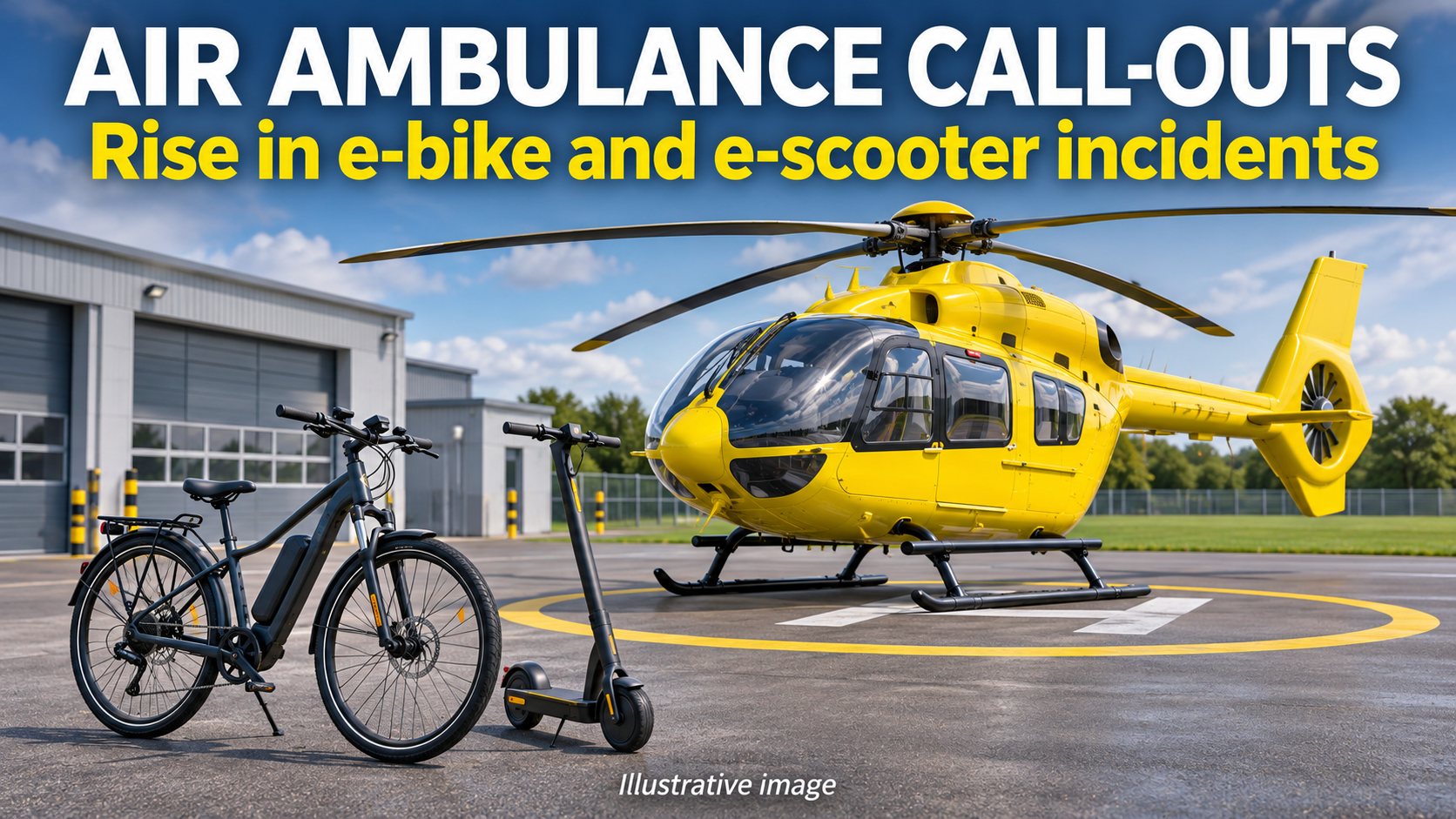
Crews attended 26 serious incidents across the three counties in the year to the end of October, up from seven over the previous 12 months.
An air ambulance charity covering Kent, Surrey and Sussex attended 26 serious incidents involving e-bikes and e-scooters in the year to 31 October 2026, compared with seven during the previous 12 months.
Within that total, call-outs involving e-bikes rose from two to 14 across the two 12-month periods, each running from 1 November to 31 October, according to figures from Air Ambulance Charity Kent Surrey Sussex (KSS) reported by Dartford Online and the Sussex Express.
The charity highlighted the figures at the start of Road Safety Week, urging e-bike and e-scooter riders to wear helmets, use lights and make sure they can be easily seen in traffic. KSS also called on drivers and other road users to look out for one another and leave plenty of room when passing.
While a jump from seven call-outs to 26 is sharp in percentage terms, the raw numbers are small and cover incidents attended by the charity’s specialist team. They do not record every collision or hospital admission across Kent, Surrey and Sussex.
On their own, call-out tallies also cannot show whether riding has become more dangerous per mile travelled. Working out how individual risk has changed would require reliable data on how many more e-bikes and e-scooters are now in daily use across the South East, alongside details that are not included in the local reports—such as how incidents were logged, who was at fault, or what types of machines were involved.
That final point is a recurring issue whenever e-bikes and e-scooters are grouped together in casualty figures, because the two sit in completely different legal brackets on UK roads.
Under government rules for electric bikes, a road-legal Electrically Assisted Pedal Cycle (EAPC) must have pedals that can propel it, an electric motor with a continuous rated power output of no more than 250 watts, and electrical assistance that cuts out once the bike reaches 15.5mph. Machines that meet those rules are treated as normal bicycles and can be ridden on roads and cycle lanes by anyone aged 14 or over without a licence, tax or insurance.
Bikes that exceed the EAPC power or motor-assistance speed limits are classed as motorcycles or mopeds and need the appropriate registration, tax, insurance, licence and helmet for road use. A throttle does not automatically make a compliant cycle a motorcycle: GOV.UK says a bike propelled without pedalling up to 15.5mph needs vehicle approval. Check the government’s electric-bike rules for the applicable requirements.
E-scooters are governed by separate rules again. Under current GOV.UK guidance, privately owned e-scooters remain illegal to use on public roads, pavements, cycle lanes and pedestrian-only areas; they can only be ridden on private land with the landowner’s permission. The only e-scooters legally allowed on public roads are those hired through authorised local council rental trials, where riders must hold the required driving licence entitlement and follow the geographic and safety rules of the local scheme.
The KSS call-out figures do not separate legal pedal-assist bikes from modified machines or privately owned scooters, nor do they imply that the riders treated by paramedics were breaking the law. What the charity’s trauma caseload does show is that when collisions involving two-wheeled electric vehicles happen at road speeds, the resulting injuries are increasingly bringing out emergency medical crews usually reserved for major road traffic crashes.

Leave a Reply
You must be logged in to post a comment.