
About The Author
Recent changes remove the need for a planning application on qualifying pavement cable channels, but drivers still need highway authority sign-off—and a space outside their front door is never guaranteed.
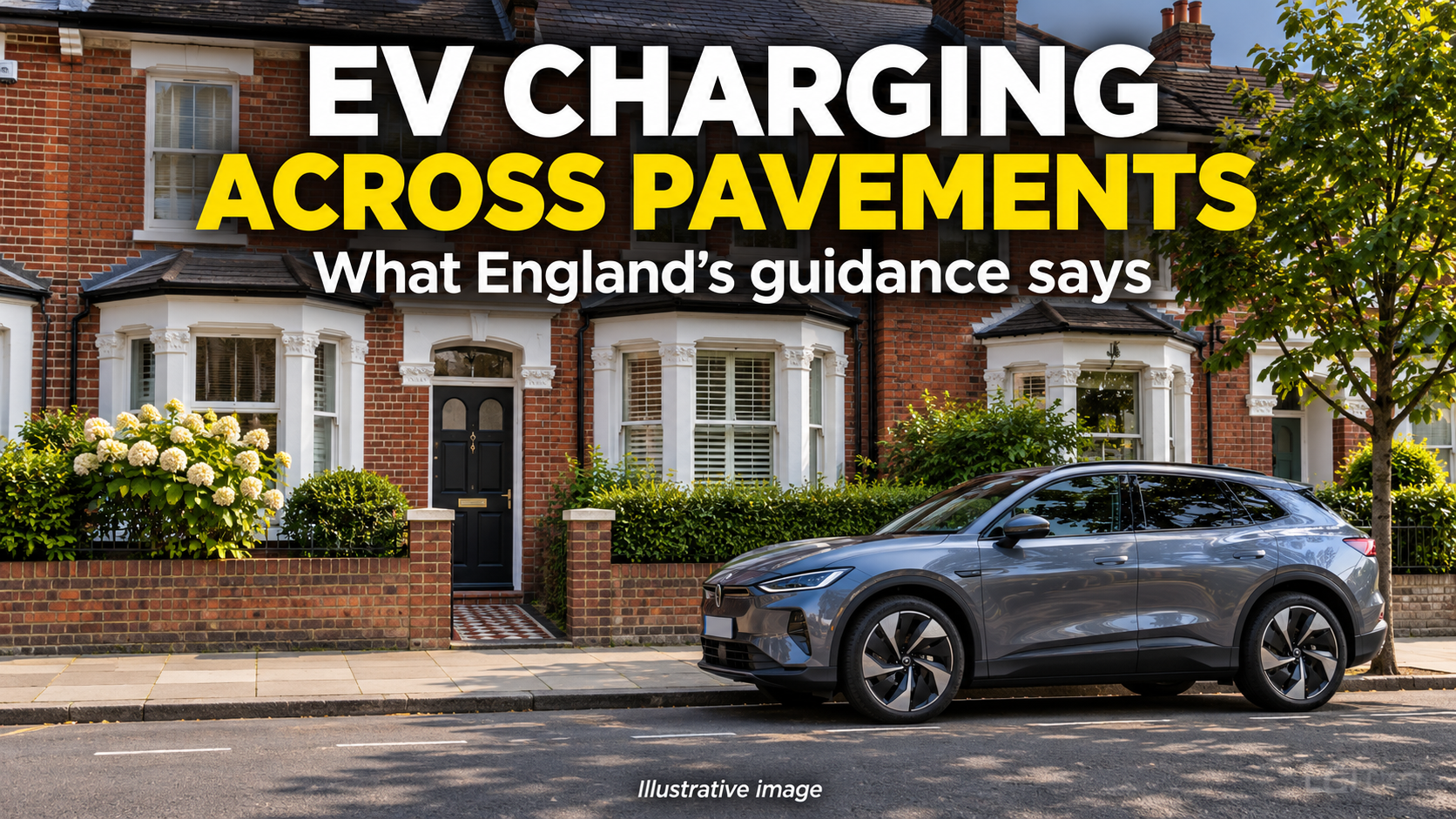
For anyone living in a terraced house or a flat without a driveway, running an electric car usually means relying on public chargers or figuring out how to get a domestic cable safely across the pavement.
A change to planning law in England, in force since 21 October 2026, is designed to remove one layer of bureaucracy from that process. It introduces a permitted development right for qualifying cross-pavement charging channels, accompanied by updated government guidance published on 4 November setting out how local councils should handle requests.
For drivers hoping to plug in at the kerb, the detail of how planning rules interact with highways law matters. Removing the need to submit a planning application does not give a householder the right to cut a slot into a public footway, nor does it force a local council to run a cross-pavement scheme.
What the planning change covers
Cross-pavement charging typically relies on a shallow metal or composite channel—often called a gully—recessed flush into the pavement. The driver drops the charging lead into the channel while the car is plugged in and removes the cable once the session is finished. While the government’s broader guidance also discusses permanent under-pavement cables linked to a kerbside bollard or socket, the new permitted development right is more specific: the legislation defines a qualifying solution as a pavement-embedded cable channel connecting domestic premises to a parked vehicle. Crucially, the installation must be carried out by, on behalf of, or with the authorisation of the local highway authority.
Alongside the rules for the channel itself, permitted development rights for home wallboxes have been widened so that houses and blocks of flats without off-street parking can install a domestic charge point without a planning application, provided both the charger and the channel meet strict conditions.
Under the government guidance, for example, a charge point fixed to a property immediately adjoining the public highway will not qualify for permitted development if it leaves less than 1.5 metres of clear footway between the unit and the road. Stricter rules also apply in protected areas. Article 4 directions in conservation areas can strip away permitted development rights altogether, and fitting a charger to a listed building may require listed building consent if the work affects its special architectural or historic character.
A transitional rule also runs until 20 October 2027, allowing certain charge point installations that qualified under the older Class D or E off-street parking rules—but fall foul of the newly amended wording—to go ahead. That transition only covers the planning status of off-street equipment and does not authorise any work in the public footway. Where an installation does not meet every condition, a full planning application may still be required.
Why the highway authority still holds the veto
Even where a setup clears every planning condition, the pavement itself remains part of the public highway. Deciding whether to allow a channel to be cut into the tarmac rests entirely with the relevant local highway authority.
Before approving a gully, council engineers have to weigh up pavement width, access for wheelchair users and pushchairs, proximity to junctions, and the tangle of shallow utility pipes and cables running beneath the surface. Depending on how a council structures its scheme, the work will require a highway works permit or a street works licence. In parts of England with two-tier local government, planning sits with the district or borough council while roads and pavements are managed by the county council, meaning residents have to deal with the highway authority’s approved scheme rather than just checking local planning rules.
What drivers cannot do is treat a loose rubber mat as a legal shortcut. The government guidance points out that trailing an exposed lead across a footway creates a trip hazard for pedestrians and may breach highways law. Temporary cable protectors and mats are not covered by the cross-pavement guidance, and motorists should not assume their local council permits them.
Costs, parking spaces and grants
Because councils across England use different operating models—some retaining ownership of the pavement channel themselves, others licensing approved private suppliers—householders need to check the small print before paying for groundwork. It is worth confirming upfront who owns and maintains the gully, who pays if it is damaged or dug up by utility contractors, and whether the council charges ongoing licence fees or requires specific public liability insurance.
There is also the practical reality of on-street parking. Having an approved channel outside your front gate does not give you ownership of, or priority over, the kerbside space next to it. If neighbours regularly park across the end of the slot, a recessed gully is of limited use unless the charging cable can safely reach the car without trailing along the road or pavement.
For drivers whose local council does sign off a pavement channel, state funding can trim the cost of the wallbox itself. The government’s chargepoint grant for households with on-street parking covers 75 per cent of the cost of buying and installing a domestic socket, capped at £500. The grant does not pay for the cost of cutting and fitting the pavement channel. To qualify, applicants must drive an eligible vehicle, use an approved installer, secure permission from their highway authority for the cross-pavement solution, and have their grant eligibility confirmed before the wallbox is fitted. Funding for the grant is currently confirmed until 31 March 2027, though the government can amend or close the scheme early.
The October planning rules and November guidance apply solely to England. Planning and road works rules are devolved in Scotland, Wales and Northern Ireland, where drivers without driveways will need to check the local policies of their own roads authority.



Leave a Reply
You must be logged in to post a comment.